Leaderboard
728x15
Showing posts with label Care Management. Show all posts

Follow-Up on Electronic Health Record Portals: We're Asking the Wrong Question (and the DMCB is guilty)

Researchers pondering the EHR portal
Thanks to Twitter, the @DisMgtCareBlog had a highly rewarding tweetologue with tweetociates @Paulflevy (with an insightful bit of bloggery here), @granitehead and @subatomicdoc about a recent DMCB post on the topic of electronic health record (EHR) patient portals. As readers will recall, yet another notion of the Lilliputian Order of Unquestioning EHR Believers failed to pass scientific muster when The Annals published a negative review on patient portals. Tweeples took note with a series of tweets that simultaneously advanced the DMCB's social media chops and the antipathy of the how-does-this-make-money? DMCB spouse.

To tell the truth, however, the skeptical DMCB took unfair advantage of this latest EHR kerfuffle. It confesses that it couldn't resist this latest addition to the target-rich environment of HIT disappointments in quality, cost and governmental overreach.

So, upon further reflection, just because almost 15 years of high quality research failed to establish any lasting value doesn't mean portals should go the way of the Dodo, low-cost medical malpractice insurance or Mr. Obama's credibility.

In other words, the DMCB does think that portals have a role to play in the health care reform landscape, and it said so in front of a huge audience at the recent Star Ratings Conference in Fort Lauderdale.

Portals, thinks the DMCB, have little value as stand-alone interventions. Just dropping it into a clinic's patient population is unlikely to significantly increase communication and shift behaviors enough to produce enough of a "signal" that cost or quality outcomes are better compared to usual care.

But when EHR portals are part of a multi-channel outreach strategy that includes (but is not limited to) mailings, interactive voice response-based calls, secure messaging, emails, social media, "anniversary" time-for-your-appointment cards, live telephony as well as home visits that are all backed by predictive modeling (who is at greatest risk) that informs "impactability" (how they're at greatest risk) that's all tethered to care management that is also closely aligned with marketing and builds brand, then portals mostly likely do add value.

Unfortunately, traditional health services research cannot assesses the multiple simultaneous interventions described above.  As Dr. Donald Berwick presciently noted in this classic JAMA article:

Experimentalists have pursued too single-mindedly the question of whether a [social] program works at the expense of knowing why it works. Thus, although [traditional research] seeks generalizable knowledge...it relies on removing most of the local details about “how” something works and about the “what” of contexts. It therefore reveals little about mechanisms or about factors that affect generalizability. Studying a few covariates, or using stratified designs, or probing for interactions can mitigate this loss, but these are inadequate tools for studying complex, unstable, nonlinear social change.

As the DMCB has noted before, absence of any proof is not the same as proof of absence.  The studies that the DMCB ultimately quoted were based on traditional research, which is simply not up to the task of the non-linear intervention of patient-doc-team communications.

Don Berwick recommends a more insightful approach:

Health care researchers who believe that their main role is to ride the brakes on change—to weigh evidence with impoverished tools, ill-fit for use—are not being as helpful as they need to be. “Where is the randomized trial?” is, for many purposes, the right question, but for many others it is the wrong question, a myopic one. A better one is broader: “What is everyone learning?” Asking the question that way will help clinicians and researchers see further in navigating toward improvement.

When it comes to EHR portals, it's time we ask just what are we learning.

More on the Definition of Care Management (and how well do IPAs and PHOs deliver on it)

Care management in action?
What is "care management?"

As discussed and quoted by the Disease Management Care Blog, here's one useful definition courtesy of the New England Journal:

"A set of activities designed to assist patients and their support systems in managing medical conditions and related psychosocial problems more effectively, with the aims of improving patients’ functional health status, enhancing the coordination of care, eliminating the duplication of services, and reducing the need for expensive medical services."

Now another one has emerged, thanks to this article by Lawrence Casalino and colleagues that appeared in the August issue of Health Affairs. The authors were interested in comparing the use of "care management processes" in small to medium sized physician-own practices that were either in or outside of an Independent Practice Association ("IPA") or Physician Hospital Organization ("PHO").

For this article, Casalino et al developed a "care management index" that reconciled five care management "processes" (1. use of a registry, 2. access to nurse care managers, 3. reliance on guideline-based reminders at the point of care, 4. sending care/health maintenance reminders to patients and 5. reporting outcomes)against the four chronic conditions asthma, heart failure, diabetes and depression. Having all 5 processes available for all four chronic conditions resulted in a top score of 4 x 5 or 20. The score therefore ranged from a high of 20 down to zero.

So, as ACO wannabes, hospital administrators, health system entrepreneurs, policymakers and regulators assess their care management landscape, they now, thanks to Health Affairs, have this handy zero to twenty scale.

To perform the study, a sample of physician-owned practices were asked to participate in a telephone survey in which the lead physician or administrator was asked about the 5 processes for each of the four conditions.

The results resembled the DMCB spouse's scoring of her husband's clean-up-after-himself processes.  There were some points, but there's plenty of room for improvement against the measured baseline. 

Small to medium-sized practices with "significant" participation in an IPA or a PHO had a average care management process score of "10.4" vs. a score of "3.8" in the unaffiliated practices.  When the care management processes were provided by the IPA or PHO to the practices, the average score was 5.4. 

The value proposition for IPAs and PHOs includes care management, but they have a ways to go.

Underwriting vs. Care Management

Rock on, care management
In the course of learning about care management, the Population Health Blog has benefitted from sitting at the feet of high-functioning finance experts, actuaries and underwriters. Reconciling health care revenue/expense, trend, monetized risk and pricing of insurance with the savings, quality and patient experience that comes from optimized care has been a fascinating - if sometimes frustrating - intellectual exercise.

However, this report on the rise of machines and the continuing displacement of knowledge workers reminded the PHB of the divide between the science and the art in this corner of health care. 

According to David Autor, it's only a matter of time until machines begin to displace the high-end brainiacs who oversee the health insurance industry's premium, reserves, claims payments and surpluses.  Human judgment will never go away, but logarithmic jumps in processing power combined with the big data that comes from industry consolidation means the "answer" on how much to charge for coverage of a person with diabetes will be less flexible and more preordained.

The PHB, however, is of good cheer. 

While underwriting risk will be all about the numbers, managing conditions within those numbers will remain a very individual enterprise. Human needs, preferences, tolerances and culture will continue to shape highly variable decision-making within the care system for years to come. The need for highly skilled knowledge workers who can help patients co-manage their care will grow, not diminish. 

Factory farms may be churning out ingredients on an massive scale, but someone has to plate the finished meal. 

The music industry may be selling Beyonce at $0.99 a pop, but nothing will replace seeing her live in concert.

Payers and buyers may commoditize cataract care, but someone has to make sure patients take their eye drops.

Underwriting on one side.  Care management on the other.  The PHB likes where it's at.  

Image from Wikipedia

Another Large Scale Research Study Confirms the Value of the Approach of Population Health Management

And here's another study, this time published in JAMA about Kaiser in Northern California that found that the following five components resulted in an increase of population-based blood pressure control: 

1. "Registry" (which the Disease Management Care Blog says is really a stand-alone database that is outside of the electronic health record);

2. "Control Rates" (which the DMCB figures is really an updated "dashboard" that displays key metrics to administrators and docs that provides feedback and helps keep everyone on the same page);

3. "Guideline" (in reality, it was a campaign to gain provider buy-in consisting of emails, publications, pocket cards, conferences, lectures and decision support);

4. "Medical assistant" follow-up operating under protocol to adjust medications (a.k.a population-based care management)

5. "Single" pill treatment (in other words, keep it simple by using pharmaceuticals that are combined in a single once a day prescription pill).

DMCB readers will not be surprised to know that the registry showed a progressive improvement in BP control (defined as less than 140/90 with the usual HEDIS® caveats) from 43.6% in 2001 to 80.4% in 2009.  Because everyone with hypertension at Kaiser was in the registry, there is no internal comparison group.  However, national and northern California HEDIS® rates for blood pressure control ranged from 55.4% to 69.4%.

While the results are 1) not necessarily generalizable outside of integrated systems like Kaiser (so we don't know for sure that this would work in a network of primary care clinics in Idaho), and 2) may have been influenced by an influx of patients with mild and easy-to-treat hypertension during the campaign), the DMCB is impressed. 

An 80% control rate for hypertension is damn good. 

The DMCB also figures that each of the interventions above are mutually supportive and even synergistic.  The whole is much greater than the sum of its parts.

How to translate this kind of success to networks of independent practices?  The answer, says the DMCB, is population health management: sponsored programs that can be owned by an insurer or a provider network that synergistically identify a population, maintain a data base, create a virtuous cycle of measurement and adjustment, get the doctors on board, deploy care managers and are smart about the pharmacy benefit.

If your a PHM service provider, vendor, consultant or stakeholder, the DMCB suggests this is one of those research papers you should bookmark, quote and aspire to.

Image from Wikipedia

17 Reasons Why Care Management Is Probably Not Going To Be in a Clinic Near You Anytime Soon

Here's a good review of all the reasons why care management has not become a routine part of patient care. 

As policymakers, reformists, consultants and architects plan for a population and outcomes-based future, they'd be wise to think about the review's 17-point reality check.

1) Start-up costs are considerable;

2) Costly to maintain;

3) Multi-year time horizon for any return on investment;

4) Any success undercuts future traditional fee-for-service revenue;

5) Can't be broken down into discreet 'reimbursible" units for fee-for-service payments;

6) It's paid for with still-novel-experimental capitated payments and/or shared savings;

7) The link between increased quality today and downstream savings tomorrow is still tenuous;

8) Complicates primary care by introducing more uncertainty;

9) Non-physician manager training is time-consuming and costly;

10) It's a resource that is best reserved for high risk patients, not all patients;

11) Doesn't fit into long-standing clinical workflows in established clinics;

12) Primary care already has enough challenges and implementing care management is not a priority;

13) Most EHRs are not configured to document or support non-physician care;

14) Decision-makers need additional information on expected net savings;

15) It relies on a lot of outside-the-doc-comfort zone behavioral, vs. "medical" health interventions;

16) It requires considerable data support;

17) It's often balkanized by multiple payers.

But be of good cheer. Jimmy Cliff reminds us that half the battle is knowing what you're up against.


The Just Right "Sweet Middle" of Care Management

Finding the "just right" middle
If you're interested in care management (definition here), there's a supportive case report in the August 7 edition of the New England Journal.

But it also makes a important point that appears to have been missed by the Editors.

The Population Health Blog explains.

The case revolves around a fragile cancer patient with abnormal blood chemistries and distributed locations of care. The author describes how care management successfully improved the patient's safety, required a lot of physician-to-physician communication and relied on care management's "reach" outside the four walls of the primary care clinic.

All good points.

However, what's also true is that prior to the cancer diagnosis, this was an otherwise well patient with post-discharge needs that were amenable to care management intervention.  In other words, this patient was "high risk, high impact." These individuals make up the narrow middle in the span of patients who range from otherwise well (destined to do OK) to disastrously complicated (destined to do poorly no matter what). 

The Population Health Blog doubts the case would have been so meaningful or successful with a routine surgery patient (stable and OK) or someone with metastatic spread of the cancer (a disaster).

The Population Health Blog is all for patient safety, doc-to-doc communication and distributed care management.  However, they're not going to be of equal benefit for every patient.  If the intent is to "save money" by reducing avoidable health care utilization, it's best aimed at the patients in the middle.

Like this one.

Physician Skepticism About the Basic Doctrines of Health Care Reform: We're In This Together and, by the way, More Believe In Care Management Than the EHR

Taking a survey...
Read these headlines assembled by Kaiser Health News and it's easy to get the impression that America's physicians believe everyone else is to blame for health care costs.  A cursory read of the underlying original research suggests otherwise.  Regardless of the interpretation, the results should give pause to anyone who thinks health care reform is a slam dunk.

The Disease Management Care Blog explains.

3900 practicing physicians were randomly selected from the AMA Physician Masterfile. Three physicians were outside the U.S., leaving 3897 docs who were mailed an 8-page survey. $20 was used to increase the response rate. Non-respondents were mailed a second and then a third follow-up. The ultimate response rate was 65% and, aside from a one year age difference, the respondents were quite similar to the original 3897. The survey that was used can be found here.

The results are nicely summarized in Table 3 (go to this link, click the "Tables" tab).

99%, 97%, 94% and 86% of the respondents felt hospitals/health systems, health insurers, pharma and trial lawyers had "potential" major or some responsibility, respectively, to lower health care costs.  95% and 98% also felt the same was true for physicians and patients, respectively.

The DMCB take: None of the answers were mutually exclusive. The physician-respondents thought everyone was responsible.  That being said, if you look at Table 3, you'll see a spread of "major" vs. "some" responsibility.  Physicians were less likely to assign "major" responsibility to themselves (prompting the headlines above) but that's because docs believe their job is to advocate for their patients regardless of cost.

Similarly high percentages of respondents generally felt that continuity of care (98%), chronic disease care coordination (98%) and reducing fraud (93%) were important means of reducing costs. What was interesting that fewer felt the same about the electronic health records (74%), penalizing docs for readmissions (41%) or bundling payments (35%). They were also less sanguine about increasing patient "skin in the game" with higher co-pays (61%) or high deductibles (58%).

The DMCB take: More physicians believed in the cost-reducing potential of disease management/care coordination than the EHR.  While part of the respondents' skepticism about the economic incentives that underlie much of health care reform is arguably motivated by self-interest, the DMCB suspects physicians also genuinely believe patient needs trump economic penalties. Regardless of the underlying thinking, the results should give pause to policymakers and politicians who believe that readmission penalties and bundled payments are a no-brainer and that docs have bought-in.

The DMCB will close with the following scenario:

Pretend you are a Vice President for Medical Affairs, or a Chief of Staff, or a health system CEO about to announce a major collaboration with a major health insurer like CMS or a Blues Plan. You've done your homework, read the journals, listened to the experts and anticipated the future. You haven't been a regular reader of the DMCB.

You've called a meeting of the physician staff - the professionals you are counting on, caring for all those patients - and your job is go to the front of the auditorium and convince them that the success of your new venture relies on lowering health care costs with new payment arrangements that align incentives, in tandem with the launch of an electronic health record.

If the survey outlined above is even partially true, would you want to be that VP, Chief or CEO?

Care Management: What a Bargain

They did it again!
Sound familiar?

Patients' intake into the program was initiated with a face-to face meeting with a nurse care manager.  After a physician-approved care plan was in place, the patients were telephoned and engaged in the protocol.  The patients could then use a voice-activated system or a website to report disease status.  Outbound nurse calls were prompted if the patients requested it, reported a problem, didn't have adequate disease control, if the medications were not being taken as prescribed or if there were side effects.  After 12 months, patients in the care management program, compared to a control group, had clinically and statistically significant improvements in the control of their condition .

To the Population Health Blog, this narrative has been repeated dozens of times involving numerous chronic health conditions.  In this latest example, Dr. Kroeknke and colleagues randomly allocated 250 patients with three months or more of chronic musculoskeletal pain to either a) state-of-the-art pain care or b) state-of-the-art pain care plus nurse led care management. 

Twelve months later (and after only one drop-out), patients in the first group rated their pain as having dropped from a baseline of 5.1 to 4.6 out of ten (zero is no pain, 10 is awful), while the second care management group rated their pain as having dropped from 5.3 to 3.6.  Total time spent by the care manager averaged 3-4 hours per patient.

While patients in the care management group were taking more medications, there was no difference between the two groups in narcotic use.  There was also no difference in health care utilization.

The PHB's take:

While the authors credited the care plans that triggered increases in medications that were tailored to patient preferences, the PHB wonders if a greater sense of control combined with the perceived support of a sympathetic listener also contributed to the greater improvement in pain.

Once again, there wasn't hard "savings" or a "return on investment."  However, the expense of only three to four hours of nurse care manager time to achieve a one-point improvement on a 0-10 scale of pain not only seems like a wise investment, it's a comparative bargain.

The MIddle Class Bubble and the Long Term Implications for Care Management & Health Care

According to this 2011 article in The Atlantic, the middle class is in trouble.  The Disease Management Care Blog agrees and wonders if they are ultimately doomed. Either way, there are important implications for health care in general and the care management industry in particular.

The amateur DMCB explains.

With the advent of the Gilded Age in the 1870s, the industrial revolution ushered in more than a century of heavy industry, railroads, mining, commercial farming and manufacturing that were powered by millions of skilled and unskilled workers. Wealth and power remained concentrated in an elite 1% plutocracy that had prevailed throughout most of human history, but a newly emergent "middle class" benefited from high wages and became an accepted part of the American political and cultural landscape.  Thanks to their labor, the quality of goods and services increased while simultaneously becoming cheaper.

While the middle class was in retreat at the turn of the millennium, The Great Recession suggests that their century-long party may be truly over. Global competition with the free movement of labor and capital combined with automation have made the costs of industry even cheaper. The plutocracy that has always been there can shrug off the effects of a recession, but the intrinsic value of traditional labor has popped, bubble fashion. 

In the last decade, persons in the nominal middle class with less than $90,000 a year in income have had flat wages and have been unable to increase their spending. Since 2000, American manufacturing - which has not only lost ground to China but become more mechanized - has lost about a third of its jobs. This has played itself out in geographic terms, where the elite hubs around Washington DC, San Francisco and Boston have high wage job listings, while cities like Detroit and Miami have been in the dumpster. In other words, much of the middle class is being hollowed out and being forced to downjob into personal services, retail and food preparation - while leading lives that are at risk for financial stress, partner conflicts, single parenting and troubled children.

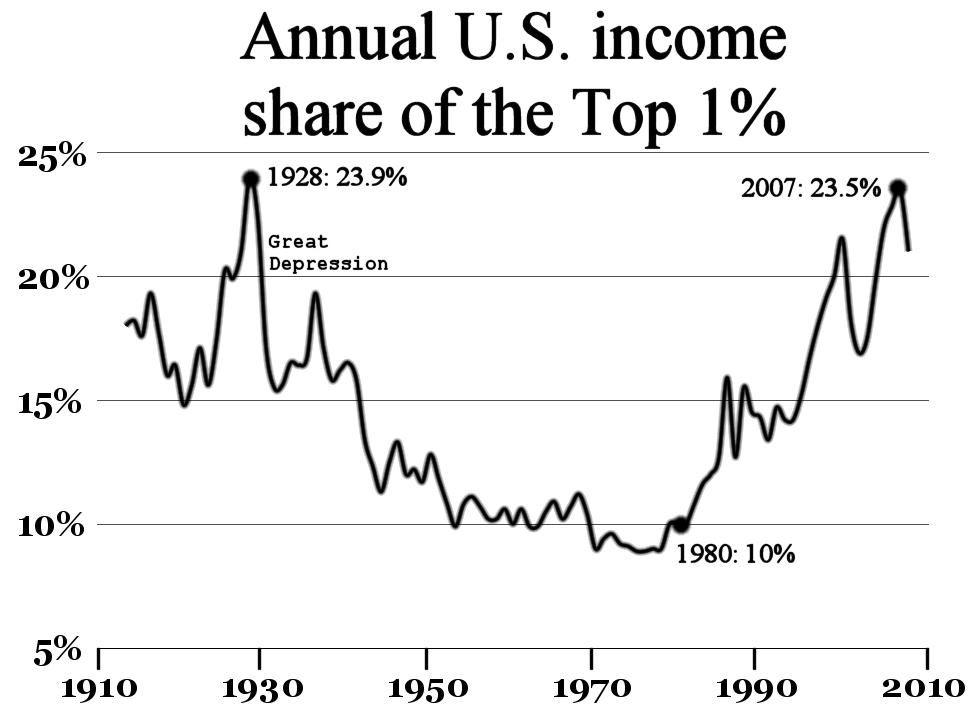
In the meantime, the DMCB suspects that the "fat cat" billionaires so reviled by progressives are not any more numerous or fantastically wealthy.  The DMCB thinks that they're only more visible.  It remains to be seen if government will be successful in moving wealth from that top 1% to the struggling 99%.  History suggests otherwise.

Long term implications for the health and care management industry:

Health care will sort into 1) high end, high touch, personalized care for a small elite that can not only afford it, but will be responsible for profitable top line revenue and 2) a strained publicly underfunded system with thin margins for the rest.  Care management providers will likewise sort into these two camps.  The first involves high margin value, the second involves low margin volume.  Given the disparate business models, it's unlikely that single companies will be able to do both.

While universal access to affordable health insurance remains a bipartisan goal, high out-of-pocket costs combined with limited provider access for persons outside of the 1% will increase the popularity of cheap "DIY" care involving eHealth. This is a natural fit for the care management industry.

Lacking factory work, more workers than anticipated may be available as the U.S. population ages and the demand for personal health care attendants increases.

Classic health care "knowledge workers" may not be immune, since information tech and automation may enable machines to generate a differential diagnosis and read an x-ray, while cheap and highly trained remote labor may be able to deply robotics to perform routine surgeries.  For the care management industry, an on-line script that prompts a nominally-trained health educator may be able to replace nurse care managers.

Image from Wikipedia

Population Health Must Include Social Determinants: The Approach in the Patient Centered Medical Home

Diabetes control isn't
their top concern
The Disease Management Care Blog's primary care colleagues are undoubtedly aware of how "social determinants" can undermine the best care planning. So, if you're going to rely on the Patient Centered Medical Home (PCMH) to increase health care quality and reduce costs, ignoring the impact of poverty or health literacy could lead to poor diabetes control, worsening high blood pressure or more hospital readmissions.

Arvin Garg, Brian Jack and Barry Zuckerman have written a JAMA "Viewpoint" that offers five lessons from pediatric medical homes that can mitigate harmful social determinants:

1) Include social determinants (for example, community factors, substance abuse, education, malnutrition or poverty) in the creation of national treatment guidelines.

2) Develop and implement screening programs to identify any social determinants that could impact medical treatment.

3) Colocate community resources that address social determinant in PCMHs.  Examples include housing programs, job training programs or food pantries.

4) Colocate "outside the box" social programs in PCMHs also.  This is an area ripe for piloting or researching innovative interventions

5) Integrate visiting nurse programs with the PCMH.  Think of the visiting nurses as an extension of the medical home.

As readers of the DMCB are aware, not all PCMH's can build the full suite of services that make up a medical home. Since health insurers and care management vendors are partnering with primary care physicians to build medical homes, this approach to incorporating social determinants in their programs is worth a closer look.

When It Comes to Nurse Care Managers in Primary Care Settings, It's Not "Build or Buy," It's INVENT or Buy

Seen one of these lately?
The Passenger Pigeon. The Dodo bird.  The primary care clinic nurse.  All are extinct, driven out existence by a changing habitat, competition and over-hunting. Ask the average person when they've last seen these species and you're likely to get the same baffled look that the of DMCB spouse gives when she's asked about her compliant husband who does what he's told.

Yet, the Disease Management Care Blog wasn't aware of the primary care nurses' total absence until a recent conversation with a nurse-colleague who has been helping smaller physician-owned outpatient offices develop local care management programs.  "There are no 'nurses'" she said. "They've all been replaced by office assistants and the docs are trying to get them to do the patient education."

Which makes sense. While articles like this have been lauding health care "teams" made up of physicians and non-physician professionals for years, the fact is that poor reimbursement, the allure of other specialties and lifestyle has long-hollowed out these clinics, often leaving a skeleton crew of part-time medical assistants shuttling patients in and out of the patient rooms.  True, some of the larger health systems with a stake in primary care have kept nurses in the mix, the DMCB thinks that's merely part of a market-preserving loss-leader strategy.

The DMCB looked for medical literature on the topic.  It can't find any surveys or other descriptions on how nurses have largely disappeared from the primary care landscape.  If it's wrong, it wants to hear from its readers.

If true, what are the implications?

  • In large swaths of the primary care landscape, there is no "build or buy."  It's invent or buy.

  • What's more, younger PCP's are even less familiar with the notion of an office-based nurse, let alone partnering with one.  Physician knowledge may have gone extinct too.

  • No wonder the Patient Centered Medical Home hasn't caught on.

  • Big Data and the Coming New Value Proposition for Disease, Care and Wellness Management Providers

    Disease Management Care Blog readers know that the its latest interest is "Big Data." While the researcher-DMCB has played in the sandbox of some insurance claims data sets, the idea of combining and combing through multiple terrabytes of clinical and public data remains a topic of endless fascination. It knows it's not alone.

    So, it was only a matter of time until one of the major clinical journals published an article on the topic. JAMA has stepped forward, and not a moment too soon.

    It's "must reading" for the disease and care management provider community.

    Drs. Murdoch and Detsky point out that Big Data offers four value propositions:

    1. Observational correlations may generate insights that cannot be found using standard research approaches. Scanning text for key words in electronic record systems involving hundreds of thousands of patients may find associations or trigger early warnings faster, quicker and cheaper than any formal scientific protocol or clinical trial.

    2. Those insights, especially since they can be tailored to fit the circumstances of an otherwise unique patient, can be used to guide diagnosis or treatment. Physician judgement cannot be replaced, but if Big Data points out that there were other patients with a similar pattern of illness who responded best to one treatment versus another, patient outcomes could improve.

    3. A Big Data approach to genomics can correlate genetic information with outcomes and further guide therapy. While the DMCB still wonders if "genomics," outside some narrow anecdotes, will always remain the science of the future, Big Data may turn out to be the key to finally unlocking its potential.

    4. Since Big Data, by its very nature, can combine clinical information to other personal data (the foods you've bought or your driving history), Big Data will necessarily tilt toward the patient-consumer and away from the health care system. Not only does permission for access lie with the patient, but the insights will be less about sickness and more about wellness.

    The authors do a good job of pointing out that there are plenty of challenges. Most doctors don't get it, privacy laws could be over-interpreted or enforced, it remains to be seen who will pay for it and Big Data is still in its infancy.  The DMCB also points out that while Medicare has just discovered that alternative research innovations are possible, Big Data promises to eclipse those approaches (like traditional time series analysis, propensity matching), again making CMS a day late and another dollar over budget.

    The implications for the care management and population health community are considerable. The industry has amassed years of intellectual capital in the science of predictive modeling and Big Data is it's next step. Many care management vendors have multiple clinical partners and already have access to terrabytes of data involving millions of persons. Not only is the math and the informatics well within reach, they also "get" the tilt toward wellness and consumer empowerment. Last but not least, if anyone can monetize a value proposition like this and turn insights into revenue (or "shared savings"), these nimble vendors can.

    A DMCB prediction: while academics will write about Big Data in scientific journals, the care management industry will be doing it.  In fact, they probably already are.

    Two particularly good quotes to use to impress your CEO and stymie your competitors:

    "Data has gone from refuse to riches."

    and

    Economic theory describes the quantitative conversion of 3 kinds of inputs (capital, labor, and raw materials) into outputs (goods and services)...The current revolution in data management makes it clear that a fourth kind of input, information, will become just as important as these other inputs in the future of many industries.
    Leaderboard