Leaderboard
728x15
Showing posts with label Health Reform. Show all posts

Electronic Health Record Portals: So What Is the Evidence That Supports Their Use?

Talk about a compelling story that went ignored.

In the November 19 issue of the Annals of Internal Medicine, Caroline Lubick Goldzweig and colleagues examined the published science on the purported advantages of electronic health record (EHR) portals.

Recall that portals are web-based entryways that on-line health consumers can reportedly use to access their records, request medications, correspond with their doctors, manage their health conditions, reduce health care costs, increase U.S. life expectancy, reduce our national dependency on jumbo-sized sugary drinks and fix everything else that ails the U.S. health system.

Unfortunately, facts have intruded.  After looking at fourteen randomized prospective trials, 21 observational, hypothesis-testing studies, five descriptive studies and six qualitative studies, the authors concluded...

 "...evidence that patient portals improve health outcomes, cost, or utilization is insufficient."

Ouch. 

In particular, any impact on diabetes care was short-lived or nonexistent, patients with heart failure had no meaningful improvement, blood pressure control did not improve and adherence to prevention recommendations were marginal.  One observational study found persons with heart failure were more likely to use the emergency room.  The only study that found any benefit involved a single randomized control trial that examined the impact of portals in the co-management of depression.

After looking at this review, depressed advocates of EHR portals may have to personally use their own portals to communicate with their docs health care medical neighborhood.

The only good news is that there were some data that suggested that a substantial number of consumers liked using the portals.  But the DMCB likes channel surfing too, but that doesn't mean that the spouse agrees that its television-watching quality has improved or that the cost of all those premium channels is moderating.

The authors pointed out that it was difficult to isolate the impact of a portal vs. a portal plus care management.  To the DMCB, that means that portals are at best a means-to-an-end of enabling care managers to better communicate with their enrollees. 

To the thousands of DMCB readers, that is not a surprise.

In the meantime, the Feds and the NCQA have one more reason to re-examine their many cherished assumptions about health information technology and the stand-alone electronic record. The last time the DMCB looked, the federal government continues to extoll portal's stand-alone virtues. The National Committee on Quality Assurance (NCQA) still includes two way communication for appointments, referrals and prescription referrals as a standard for the medical home.  Finally, the Fed's promotion of the electronic health record (EHR) approves of portals as an option in meeting meaningful use criteria.

Image from Wikipedia

Dr. Berwick Discovers Toxic Politics Too Late

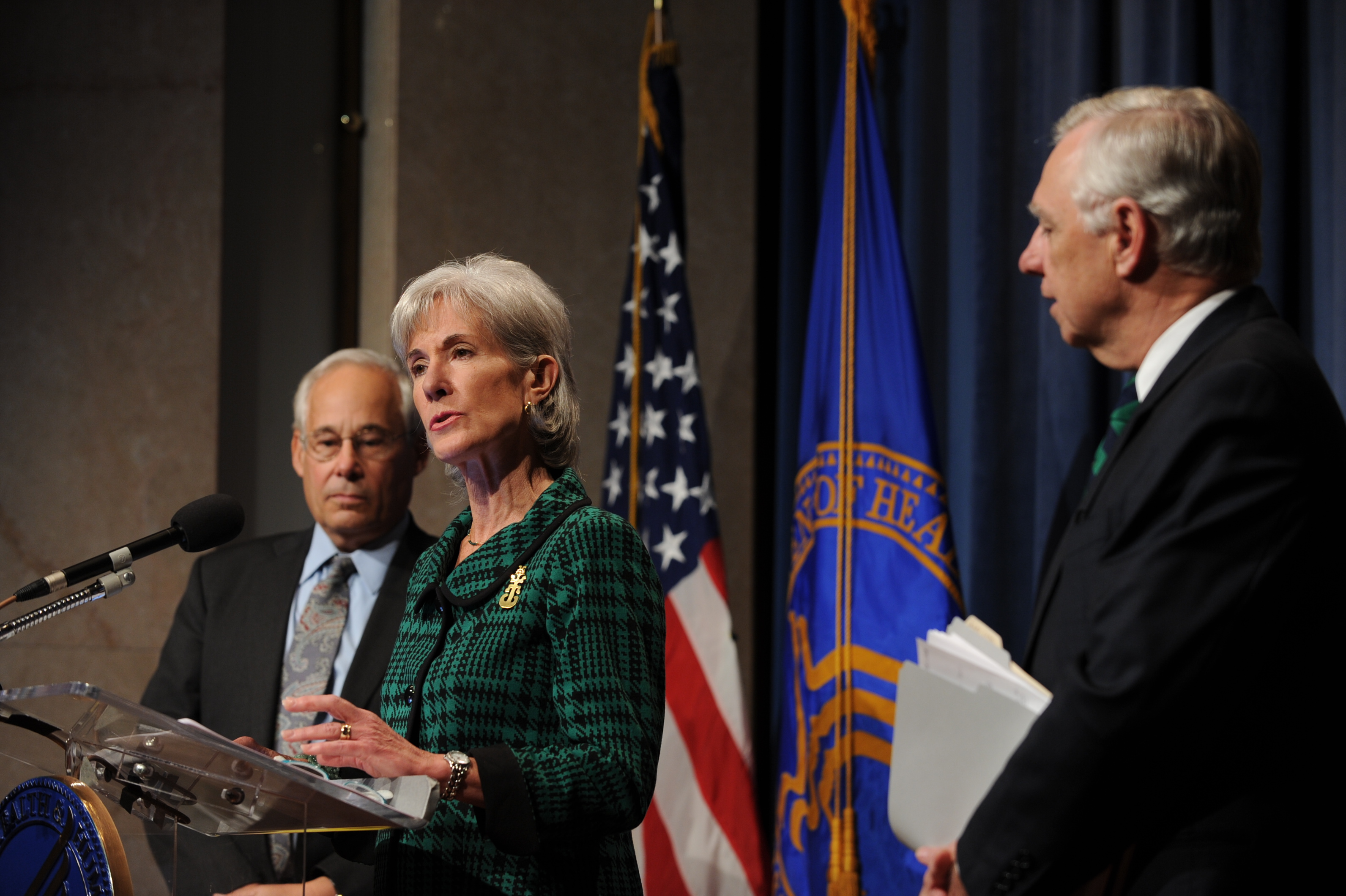
Dr. Berwick listens to Ms. Sebelius
If you're interested in a post-mortem of Dr. Donald Berwick's failure to be confirmed as CMS Administrator, check out his November 13 JAMA article on "The Toxic Politics of Health Care." 

He identifies six causes of our national discontent, which the social media-minded Disease Management Care Blog has boiled down into 140 character or less tweetable summaries:

Money: there are too many entities making too much money to give up on the status quo. "Reducing costs" means cutting into someone's income.

Unorganized majority latent interests: the majority of Americans can't see or translate their interests into effective political action.

The Silence of Professions: Organized medicine has been all about the SGR and tort reform.  They should advocate for health reform.

Suspicion of Science: public trust in science is eroding because of its elitism. That, in turn, feeds into fear of rationing.

Duality of self interest: a lot of people work in the health care industry. Cutting costs will add to U.S. unemployment woes.

Ambivalence about Federalism: it's difficult to develop a coherent national health policy when power is shared with the states.

Ambivalence about the poor: it's difficult to convince the U.S. electorate that disadvantaged populations deserve public support.

For the record, the DMCB openly supported Dr. Berwick's nomination and still feels that he would have ably served his country as CMS Administrator.  That being said, one cause for his undoing was his failure identify these issues before he was forced to leave Administration. 

Docs like Dr. Berwick - and that includes the DMCB - unfortunately think that all they need are the facts to win the day. Not so: they need to address the money, catalyze coalitions, nudge stakeholders, reconcile multiple interests, cut deals and still do what's right.

He was the wrong guy at the wrong time.

More On Why The Prognosis of Accountable Care Organizations (ACOs) Is Guarded and How Should Population Health Management Providers Position Themselves


For a long time, the more than 5000 regular visitors to the Disease Management Care Blog have been aware of the gap separating the promise and reality of Accountable Care Organizations (ACOs). That's why the DMCB salutes the editors of Health Affairs, who have decided it's time to extend the same courtesy to its readership with a well written article by Lawton Burns and Mark Pauly titled "Accountable Care Organizations May Have Difficulty Avoiding The Failures Of Integrated Delivery Networks Of The 1990s."

Remember the 1990's style integrated physician-hospital delivery systems? The DMCB sure does. Like the modern ACOs, these systems' business model were also based on care coordination, incentives alignment, risk bearing, salaried physicians and horizontal and vertical organization.

According to Drs. Burns and Pauly, they flamed out because they paid physicians too much for their practices, lacked adequate information technology, failed to achieve economies of scale, couldn't coordinate care and entered into "piecemeal" capitated contracts.  Last but not least, the typical 1990's style integrated system was never really "integrated" at all: it was made up of multiple provider entities that were simply bolted together.

ACO advocates argue it's going to be really different this time. Information technology is cheaper and more robust, new payment approaches (such as upside risk and bundled payments) are more user friendly, health care administrators are more adept at squeezing costs from the system and purchasers are demanding value over volume.  Toss in patient-centeredness, accountability, transparency, paying zero for physicians' practices and the momentum of federal payment reform, and it's easy to see why ACO-skeptics like the DMCB readers are being viewed as paper-medical record-loving party-pooping pinheads who pine for fee-for-service.

For the record, the DMCB categorically denies being a pinhead. But it and Drs. Burns and Pauly agree there are plenty of reasons to be skeptical.  Among the article's points that resonated with the DMCB are:

1) Most attempts at hospital-physician integration have not ended well, thanks to conflicting goals have not achieved quality, cost, cooperation or integration. Will economics and information technology finally trump culture?  We'll see.

2) Care coordination is no less difficult compared to the 1990s because it not only relies on timely information, but patient self management and nurse coordinators. The parallel flame-out of early versions of disease management also taught us that it is not a panacea for all patients with all chronic conditions being cared for by multiple providers in open networks. It works best when it is targeted at persons with a high burden of disease with readiness to change.

3) Medical homes take years to develop, thanks to years of transformative change management. Just because you're an ACO doesn't mean you're good at it and, what's more, you don't have years.

4) Clinically-based health information technology such as point-of-care decision support, electronic records and computerized physician entry have been inconsistently successful. And that's being generous.

But the authors don't stop there.  They describe four ACO "Achilles heels":

1) If PCPs are truly the linchpin to ACOs' success, it should also be pointed out that they are in short supply. It remains to be seen if they'll welcome a loss of professional autonomy or be willing to accept compensation that remains a fraction of their specialist colleagues;

2) Assuming large integrated systems comprised of a hundred or more physicians are truly able to achieve economies of scale, they won't spontaneously appear.  They take years to develop and mature.  See medical homes above.

3) Utilization of health care services outside an ACO's network not only outside their control but is very expensive, and

4) Maybe ACOs are a "disruptive technology" but the ultimate judge will be consumers.  They have yet to weigh in.

Implications for the population health management (PHM) service providers:

1. As ACOs struggle with their primary care providers and scramble for medical home and large health system-style care coordination services, "outsourced" nurse-based coaching will be very much in demand. But you already know this.

2. Given their national footprint, PHM providers may be in the best position to assist with those out of network or out of state ACO enrollees.  That's a new thought.

3. Keep a Plan B available just in case, and despite your help, ACOs collapse of their own weight.

"Down Jobbing" to Primary Care Technicians?

Heard of "down-jobbing?"
Your PCT will see you now.....

The Disease Management Care Blog first became aware of the term years ago when it was pointed out that primary care docs can take on some specialty care responsibilities, while nurses can take on primary care roles, while office assistants can take on nursing roles. A parallel phenomenon is the movement of surgeries and other medical procedures from the inpatient to the outpatient surgi-center to the physician's office.

Naturally, the ultimate down-jobbing target is the patient. Examples include the reasonable innovation of self-service kiosks as well as emergency or wacky "self surgery."

Which naturally prompts the DMCB to offer it's own definition of down-jobbing: the historical movement of medical treatment from higher to lower levels or locations of health care services.

Of course, the major driver of down-jobbing is economics. DMCB readers are well aware of our national obsession with transitioning from "fee-for-service" (FFS) to more "value-based" reimbursement arrangements. These include pay-for-performance as well as shared-risk, global or other capitated approaches.

Since traditional FFS is notoriously linked to medical necessity as well as provider credentialing (examples are not hard to find), physicians have had little incentive to go along with down-jobbing. As FFS allegedly goes the way of the dinosaurs (a perspective likewise not hard to find), health care providers in these new value-based payment systems are looking for cost-effective ways to service their patients within a fixed budget or fixed payment system. One way to do that is to down-job.

So it was only a matter of time until someone thought of the option of "primary care technicians" ("PCTs") as a value-based and down-jobbed solution to the nation's physician shortage. As Kellermann et al point out in the November 2015 issue of Health Affairs, the pipeline for primary care docs, physician assistants, nurse practitioners is not only expensive, it's unlikely to meet future demand.  They argue that PCTs can be to primary care providers like emergency medical technicians (EMTs) are to emergency care rooms.  Like EMTs, PCT training to handle preventive care, treatment of minor illnesses and monitoring chronic conditions needn't be extensive. That's especially true if PCTs are armed with a health IT safety net that provides tablet-based decision-support algorithms that are ultimately tethered to (or teamed with?) a primary care physician.

So there you go: a few questions, a cursory exam and a recommended treatment plan for millions of healthcare hungry Americans is well within reach.  All it takes is some additional down-jobbing.

The DMCB thinks that, on paper, it's not a bad idea and no accident that it would appear in the academic health policy literature.  Whether this could gain any traction in the real world of patients remains to be seen.  Perhaps the next step is a randomized controlled clinical trial comparing the outcomes of patients seeing newly minted PCTs to those receiving usual care.

The DMCB has two additional concerns:

1. The promise of the expansion of access to health insurance under the current iteration of health reform was that patients would be able to access the current health care system, including doctors and hospitals.  Even if this system of primary care meet outcome expectations, this will hardly burnish American's ambivalent views of Obamacare.

2. Liability concerns are significant. Allegations of malpractice are inevitable with PCTs and their supervising docs will naturally worry about being ensnared in even more lawsuits by a very nimble plaintiffs' bar.

Image from Wikipedia

The Magnificent Carnac Again Speaks to Health Care Reform!

Visitated once again by the astral, magnificent, all-knowing and soothsaying Carnac, the Disease Management Care Blog has divined his answers to the questions swirling around the healthcare.com roll-out debacle.

As Tonight Show Johnny Carson fans know, the prescient Carnac can foretell answers before the questions have even been asked by Congress and its allies in the punditosphere! By merely holding an hermetically sealed envelope containing the question, the mighty Carnac would provide astounded observers with the answer.

Behold the wisdom of Carnac's answers:

"Six"....

That is NOT the number of individuals securing insurance on the first day of the website! Rather, it is the answer to the question:

"How many million lines of computer code need to be changed to fix the Healthcare.gov web site?"

"Healthcare dot gov and the DMCB spouse"....

The question: "Name one thing that won't work and one person who won't twerk."

"Grits, Glitz and Glitch"....

The question: "Name an excuse for breakfast, zirconium and a government sponsored website."

"Burger King, Viagra dot com and the misstatements surrounding the Affordable Care Act"....

The question: "Name three homes for "The Whopper."

"Zero Dark Thirty"....

The question: "Name three descriptions of what happened to President Obama's approval ratings following the roll out of healthcare.com."

More information on the image can be found here.

The Health Wonk Review: An Example of the Facts, Education and Spin Behind the Lingering Debate on Obamacare and Health Reform

 
Modern political discourse
The Disease Management Care Blog had a Hurricane Sandy choice: either a) leave day before that early A.M. hospital procedure and stay with friends who live close by, or b) stay at home and make the long trip in the wind and the rain to the hospital that same morning.  The DMCB spouse turned to repetitive education to help the DMCB make the right choice.

Does that learning tactic underlie Obamacare supporter Maggie Mahar's approach to the latest Health Wonk Review?  That's what the DMCB thought when it read Maggie's posting.

To help the thousands of health reform realists who make up the DMCB readership, Hurricane Maggie repetitively retreads the cost-control talking points from reform architect Peter Orszag, surgeon Golden Boy Atul Gawande and the White House Office of Management and Budget  Rest assured, says Maggie, if you selectively counter the DMCB's fiction with facts, you'll realize Washington DC's solutions are the right choice.

The DMCB isn't too sure about that.

Maggie doesn't argue health care costs aren't rising, only that the increases are less than widely claimed.  She credits Obamacare.  The Disease Management Care Blog agrees that cost trends are moderating, but it also credits a lackluster economy.

Maggie says be of good cheer, because the increased costs are delivering correspondingly better value for the health care dollar. The DMCB says value remains an inexact science that is ill-suited to simplistic nostrums and blunt force laws and regulations. The latest examples of this conundrum include mammograms and annual check ups.  There are plenty of others like this.

Maggie points to Massachusetts's Atul Gawande's brimming optimism about Massachusetts leading the way with risk and performance contracting as a cost-control panacea.  The DMCB awaits the arrival of hard macroeconomic outcomes data that proves the experiment works.  It also points out that the Bay State's recently passed cost control legislation speaks volumes on what that state's leaders really think about the savings-success of Romneycare.

Last but not least, not everyone on the blue side of political spectrum shares Maggie's optimism.

By the way, the DMCB has received a cost estimate from the unnamed hospital mentioned above. That institution is the flagship part of a nationally recognized integrated delivery system that is a basis for much of Maggie Mahar's enthusiasm. The DMCB's planned procedure coupled with OR charges and an overnight stay will result in charges, prior to discounts and contracted rates, in excess of $100,000.

For those of us with a lingering doubt that our political class's health reform sound-bites, nostrums, talking points and pronouncements will cut through all those inconvenient facts, the DMCB recommends this catchy tune.  You'll feel a lot better:


Image from Wikipedia

Access, Affordability and Quality: Only A Third of the Work Is Done

Access, affordability, quality
Did you know that the taxpayer costs of some versions of public transportation have proven so expensive, that it would have been cheaper to provide each rider with their own BMW

Which is why the Disease Management Care Blog, which always uses public transportation in and out of the SFO, ORD, ATL, PHL airports, ascertained that it was time for it to make its coupe selection. Unknown to the DMCB spouse, it has started to examine the trade-offs between bimmer cost, speed and comfort.

Which reminds the DMCB of the parallel universe of health care.

In its travels around Washington DC, the Disease Management Care Blog has repeatedly heard that the health reform likewise involves trade-offs between the three similar goals of 1) access, 2) affordability or 3) quality. Historically, most health reform proposals have managed to secure two out of three. A good summary of the historical travails of this "iron triangle" can be found here.

Which is why conservative-leaning Gail Wilensky's examination of Obamacare in the Oct 18 issue of the New England Journal makes for good reading. She finds the President's signature achievement wanting because it only delivers on on the single goal of access. 

Thanks to the law, 30 million Americans will soon be able to get coverage.  Approximately half will obtain subsidized private insurance  and the other half will be able to qualify for Medicaid. 

All well and good, except a substantial proportion of Americans remain philosophically skeptical of the law's merits. Whether you agree with the skeptics or not, it's still feeding a lingering partisan divide that continues to chew up precious political capital.

And, according to Ms. Wilensky, that was the easy part. Affordability and quality remain serious challenges.

That's because, despite some promising (but ultimately still unproven) innovations involving bundled payments and shared risk, Obamacare leaves Medicare's fee-for service reimbursement very much intact for years to come.  That means quality will continue to disappoint and costs (i.e. affordability) will take a greater and greater share of America's gross domestic product.

Disagree?  While Ms. Wilensky may be criticized by partisans as a market-oriented Republican shill, the DMCB has seen her up close, in-person and in action: she's smart, always makes good points and when she speaks about the Affordable Care Act, the rest of us should listen:

1) Some of the anticipated savings of Obamacare that went into budget planning included a curious item called "productivity adjustments."  This was based on the assumption that the health system would achieve greater efficiencies long before any of the Affordable Care Acts payment innovations are a) proven and b) imposed on the majority of providers.

2) The Relative Based Value Scale is fundamentally untouched and continues to reward physicians for high margin services instead of efficiency.

3) The much ballyhooed value-based payment bonuses are quite modest and an unlikely to significantly alter hospitals' approach to doing business.

4) Congress' past vulnerability to special interests and the low likelihood that the Independent Payment Advisory Board will change physician behavior does not inspire confidence.

5) While supporters believe the law will incent value-driven market behaviors, it's ultimately Washington DC - not consumers and certainly not markets - that will reward the winners and losers.

6)  The prospects surrounding the looming fiscal cliff and SGR remind us that cutting fees are not the same as cutting costs.

One third full versus two thirds empty?  Perhaps.  Depressing?  Maybe.  An accurate portrayal of bad times to come?  Maybe not.  Better, says the DMCB to know what we're potentially up against and the hard choices we still have to make between affordability, quality and access.

Addendum:  If you got here thanks to Maggie Mahar's Health Wonk Review, a friendly rebuttal to her partisan spin can be found here.  The DMCB linked that up on the Reply part of the HWR posting but it's gone missing.

The Progressives' Point of View When It Comes to Health Reform

While the Disease Management Care Blog tries to be an equal opportunity cynic and generally sides with policy underdogs and lost causes, it supposes that its conservative leanings sometimes comes through in its writing. 

That was enough to prompt a series of well-written email exchanges with Greg Brown, a retired educator from the Kansas City area. He did a great job of compactly summarizing the views of supporters of the current version of health reform. 

It seems to boil down to five main arguments:

1. Medicare and Social Security: While passage of these landmark safety net programs was likewise met with deep concerns about the erosion of liberty, their ultimate success cannot be denied.  Most of the persons who are against the Affordable Care Act are ironically happy to have the feds appropriate a portion of their income in exchange for economic security in their old age. They can't have it both ways.

2. This is not buying shoes:  One role of the federal government is to step in when markets fail, and that has been amply demonstrated when it comes to health insurance. While it's difficult enough to remember to even buy a product that you may not need, shopping for the best value in commercial insurance is practically impossible.  Proposals to expand this unworkable solution are a pipedream.

3. The public good: Keeping people from going bankrupt in the course of an unexpected illness is everyone's interest.  It's ultimately a better bargain for society to proactively manage this with near-universal insurance than to deal with poverty after the fact.

4. Purchasing power: To date, Washington DC has chosen to not flex its purchasing power with providers.  Think of how much cheaper drugs would be if Medicare leveraged this for Part D.  Just wait until the happens in the rest of health care system and how much all of us will all benefit. 

4. Status quo: Even if you don't accept the track record of Medicare, the realities of buying insurance, the merits of a public good and the advantages of purchasing power, the status quo has led the U.S., compared to the rest of the developed world, to be a unsustainable per-capita cost outlier.  Something has to change. and theACA is doing just that.

I am not an expert by any stretch. I am just an interested layman. I really wish Obama had pushed for a single payer or at least a strong government alternative delivery system. But here we are and as imperfect as it is, it is the best thing I see on the horizon right now. It does at least attempt some cost controls, it broadens access, and it may lead to better quality with a focus on health outcomes rather than billable procedures. At least it attempts to address all three.

Image from Wikipedia

Pearls from the Care Continuum Alliance Forum12

The Disease Management Care Blog is recovering from a case of post-oratory exhaustion following today's Care Continuum Alliance Forum12 sermon.  Happily, it delivered the session payload without any impolitic gaffs, wardrobe malfunctions, unsightly hives or gastrointestinal afflictions.

It's also grateful for all the pre-event PowerPoint advice that it got (you know who you are).

Nonetheless, the DMCB steeled itself and attended a host of educational follow-up sessions over the remainder of the day and scribbled down some of the better pearls of wisdom:

Americans, without exception, distrust all large institutions.  That prompted the DMCB to wonder again about the prognosis of the ACO business model.

People trust persons like themselves.  This used to mean just friends, neighbors and family, but now includes social media circles.  Health providers ignore the implications of that at their peril.

Consumers do not equate healthcare information with healthcare solutions.

A goal of old age is to live with inevitable chronic illness without being sick.

HIPAA compliant on-line authentication is moving away from entering an email address to entering a cell phone number.  Email accounts change, but people tend to keep the same cell number even if they change phones or carriers.

Ideal clinical work flows from a Patient Centered Medical Home is circuitous: the patient never exits.

From "Reviewing Committees" to "Death Panels": Media Disdain for the 40% of Americans Who Are Getting It Right?


Two thirds' way through a delicious sauv blanc with some family, the Disease Management Care Blog happily announced that the spouse had agreed to purchasing an even larger flat screen television that included internet functionality.  When the spouse naturally protested, a carefully conducted forensic review of the past conversation that led the DMCB to its sadly mistaken impression revealed what really happened: the spouse really indicated she might be willing to think about it.*

Was the DMCB intentionally twisting words to fulfill a self-serving technology-addled agenda?  Or, did its morbid fascination with gadgetry unintentionally bias its recall?  Or, was it just an honest mistake?

For a better example of the mistakenly unintentional intentionality over what gets said and what gets reported, check out what happened with a recent Associated Press poll that assessed Americans' knowledge and opinion of Obamacare. Here's a link to the survey.

Among the many questions was one that did not deal with "death panels."  Instead, this was the very reasonable and tone-neutral question that appeared toward the end of the survey:

Do you think that the new law will or will not do the following after the law is fully in effect? [Create committees of people who will review the medical histories of some people and decide whether they can get medical care paid for by the federal government.] 

And here's the AP news report on the results of the survey.  The DMCB provides the headline and then the paragraph that dealt with the question's results above. 

AP-GfK Poll: Most see health law being implemented

Misconceptions about the law that reigned two years ago live on, including former Alaska Gov. Sarah Palin's widely debunked charge that it would create "death panels" to decide on care for the elderly and disabled. In 2010, 39 percent believed the law would set up committees to review individual medical records and decide who gets care paid for by the government. Forty-one percent still hold that view, according to the poll (Here's the link to the AP Newswire Report)

Note that the AP headline does not mention "death panels." However, the paragraph pasted above explicitly links "death panels" to a benign survey question on "reviewing medical histories." 

At least the misleading paragraph was buried toward the end of the article.

Not so with the widely read The Hill.

Poll: Four in 10 believe in Obama healthcare law ‘death panels’

About four in 10 U.S. adults believe that President Obama's healthcare reform law will create "death panels" to decide patients' fitness for care, according to a new Associated Press-GfK survey.

Support for the widely challenged claim has remained steady since 2010, when 39 percent believed "death panels" would result from the healthcare law. Today, 41 percent say the same is true. (link to The Hill article)

So, is the lingering fixation on "death panels" by major news outlets an accurate reinterpretation of Americans' true opinions?  Or, does it portray a tut-tuting disdain by the national media for the 39% to 41% of Americans who are mistakenly worried about the intrusion of government into medical decision-making?  Or, is the DMCB just being touchy about an honest mistake?

You decide.

By the way, the 41% are ironically and technically quite correct answering affirmatively to "committees will review the medical histories of some people and decide whether they can get medical care paid for by the federal government."  Appeals and grievances over denials of coverage by health insurers have been handled by "committees" for years, including fee-for-service Medicare.  Go to this document on Medicare Appeals, scroll to page 18 and you'll find this quote on what inpatient beneficiaries should do if they feel they are being unfairly denied coverage medical services:

The Quality Improvement Organization will look at your medical information provided by the hospital and will also ask you for your opinion. The QIO will decide if you’re ready to be discharged within 1 day of getting the requested information (bolding DMCB; you can read about QIOs here).


*In the interest of full disclosure, the spouse says even the "think about it" characterization is generous.  Instead, she recalls saying "no."  The DMCB will continue to explore her real thinking on this matter.

The "Cost Disease" of Health Care: William Baumol's Surprising Perspectives on Why It's Unavoidable and Not That Bad


Disease Management Care Blog readers know that its three favorite themes are:

1. While health care costs have gone up, patients are benefiting from relatively greater parallel increases in value. For example, compared to just a few years ago, cancer and heart attack survival rates are much better.

2. As societies grow more affluent, they are more willing to pay more for that higher value health care.  While the U.S. is an outlier in absolute per capita costs, all developed countries have the same rate of year over year cost increases.  In fact, some countries are higher health care inflation rates than the U.S.

3. The ability of government to referee the cost, value and affordability dimensions of health care is doubtful.

William Baumol's book "The Cost Disease: Why Computer Get Cheaper and Health Care Doesn't" suggests the DMCB may have two out of three correct.  The DMCB was alerted to this book thanks to an Economist review and is about half way through it.  What it's read so far is eye opening.

According Professor Baumol, a nation's health care costs should be contrasted with the rest of its economy.  Using that perspective, two national economic sectors are:

1) progressive, which uses innovations to reduce labor costs and

2) stagnant, which relies on personal services and will always have fixed labor costs.

Examples of progressive goods are automobiles and computers.  In inflation-adjusted terms, their costs have dropped precipitously. That's because fewer workers are needed per car (translating into lower labor costs), technology has made them more efficient, safe and fun.  Not only do we feel wealthy, the drop in progressive costs of transportation, housing and food means we really are more wealthy.

Examples of stagnant goods are education and health care. In inflation-adjusted terms, their costs have remained stubbornly elevated. There have been some attempts at "do it yourself" learning or treatment. There have been stunning advances in the science health care.  Distance learning is a growing option.  Yet, teaching and doctoring remain remain highly personalized, Human resource costs rule when it comes to individualized care.

In simple mathematical terms, the falling costs of the progressive goods and services translates into a shrinking fraction of an economy.  While the absolute number of computers and cars is increasing, their absolute dollar value - which is the metric used to measure a nation's gross domestic product (GDP) - is lower.  As a result, the denominator is smaller, making the percent of GDP going to health care (the numerator) relatively larger.  Health care costs aren't really going up, the cost of everything else is going down.

But wait, it gets worse. As labor gets squeezed out of the progressive economic sector, two things are happening:

a) the value of progressive manual labor is dropping, leading to falling wages for millions of unlucky Americans who are not "knowledge" workers (like engineers and technologists);

b)  because less of everyone's income will be spent on stuff like cars and computers, they'll see a greater percent of their income going toward - you guessed it -  health care and education.  That means the unlucky manual workers unable to find jobs in progressive manufacturing will find that education and health care are unaffordable.

Enter government.  Whether we planned it or not, government has traditionally supported stagnant services. This not only includes health care and education, but others that are fundamentally personal, like policing, sanitation and the military.  As a result, even if the U.S. government doesn't change a thing, it's inevitable that health care will occupy a greater portion of a nation's GDP.  And since displaced workers from the progressive sector can't afford it, it makes sense for government to expand what it's been doing all along.

Bottom line?  "Rising" health care costs are a function of its highly personal nature surrounded by an increasingly efficient economy that enables us and our government to pay for it.  Dr. Baumol calls this phenomenon "cost disease."

Dr. Baumol makes two other points:

1) The fundamental danger to society is not the rising costs of education and health care.  It's the falling progressive price of weapons (from AK-47s to nuclear bombs) and the pollution from expanded manufacturing (from oil spills to global warming).

2) Many decade's worth of past attempts to blunt health care costs as GDP rises have failed and will continue to do so.   

The Death of Private Practice?

Private practice faces the future?
Quick: if you were asked how many practicing physicians have bailed out of private practice and have become employees of large corporations, regional hospitals, accountable care organizations or multi-site clinic groups, would you say.... a majority?  A huge majority?

You'd be wrong.  Most mainstream media reports on the decline of private practice either project the rise of large medical groups or have (shockingly) engaged in anecdotes. In other words, a killer version of the flu is not going to kill millions anytime soonglobal warming is not going to result in the sea flooding of central Pennsylvania (at least not tomorrow) and private practice is not dead.

So says this report by the American Medical Association. Using the Physician Practice Benchmark Survey on a representative sample of physicians doing hands-on care more than 20 hours a week, 53.2% of respondents were full or part owners of their practices, while 41.8% described themselves as employed.  Compared to a similar survey in 2007/2008, the number of owners declined by 8%

Surgical specialists (a high of 71.9%) were more likely than adult primary care (50% to 56%) to be owners.  Approximately 60% of physicians work in groups of ten or less and about 18% of physicians are in solo practice. 

Only 23% of physicians were in practices that were partially or wholly owned by hospitals.

While this information isn't all that surprising to DMCB readers, it does point to a slow gradual decline in small physician-owned groups.  That decline, however:

1. does not point to a nation-wide collapse of private practices, which still remain the largest piece of the physician-cased care system, and

2. does not line up a bunch of points that inexorably lead to zero.  In other words, it's just as possible that the slow decline could accelerate or remain the same or level off.

3. does point how important it will be for policymakers, regulators and politicians to consider the well being of small physician groups when they concoct their proclamations on such things as electronic records (very capital intensive), payment reforms (can hurt small business cash flows) or fraud and abuse (audits can bully small practices).

4. is potentially questionable because, once again, the DMCB has to contend with a report that hasn't gone through independent third party review.  It hopes that some or all of the data is eventually reported in a reputable journal.

Coda:

Just in case you're like most smart DMCB readers and want to know the methodologic details: This survey sample came from the 155,000 users of "Epocrates" who use the app to access information about medications; according to the AMA, this pool of physicians appeared to be quite similar to the more than 600,000 physicians who are in the AMA Masterfile. 14,750 Epocrates physicians were asked to participate in the survey and the response rate was 28%.  The responses were "statistically weighted" to match the Masterfile.

Image from Wikipedia

The "Coporatization" of U.S. Health Care: Why the Good Prognosis for Health Insurers & ACOs May Be Guaranteed

Corporatization
The Disease Management Care Blog is ashamed to admit it, but it's reading Edward Klein's The Amateur. While much of the book is a conservative-partisan rehash of Mr. Obama's alleged personal and political shortcomings, it did raise one issue that intrigued the DMCB:

"Corporatization."   It seems this White House likes it.

As the DMCB understands it, this is a policy agenda that favors the formation of huge corporate organizations that dominate the national business climate. Its argument is that, thanks to their size and scope, these gigantic private, public and not-for profit corporations are better able to marshal the resources it takes to launch transformative programs, achieve efficiencies, take risks and make profits that are beyond the normal reach of traditional commerce. Think about the hundreds of billions-of-dollars-approaches to housing, financial services, battery operated cars, high speed rail, solar power, privatized space travel and, last but not least, health care insurance and delivery.

A key ingredient of corporatization is "partnering" with government in a way that blurs the line between private enterprise and the public interest. Ingredients include government-backed financing, special tax breaks, loans, grants, mixed Boards of Directors and sovereign investment funds.  The downsides are quite familiar also: crony capitalism and too-big-to-fail status 

The best example of corporatization is China. Beijing centrally orchestrates many of its key economic sectors including finance, banking, housing, public transportation and heavy industry with an opaque mix of public and private companies. While political reforms and respect for human rights have been found wanting, the prospect that China could eclipse the United States in the next 25 years has prompted many in the U.S. to admire China and reexamine the merits of old fashioned capitalism and unfettered markets. For an interesting example of that thinking, see this editorial by Andy Stern that recently appeared in the Wall Street Journal.

What could this explain and what are the implications?

1. The abandonment of the government-run "public option" early in the course of creating the Affordable Care Act. Despite his hostile anti-insurer rhetoric, Mr. Obama's ultimate belief in large mega-insurance corporations, a) regulations and b) public subsidies that bind the behemoth insurers to D.C. won the day.  And it ain't going away anytime soon.

2. The near ideological support by this Administration for Accountable Care Organizations. Despite little track record that ACOs offer a viable business model, the notion of large regional providers partnering with and led by CMS is fully consistent with a belief in corporatization.  This makes the DMCB wonder if Mr. Obama's intent is to assure that ACOs succeed, no matter what.

A Brainy Health Wonk Review on Health Reform, the Affordable Care Act and Lots More!

Welcome to the Disease Management Care Blog, your host for this edition of the Health Wonk Review. This is a linked summary of the latest and best postings from an informal community of health policy bloggers with informed insights that readers, business leaders, academics and policymakers won't find anywhere else. We invite you to sit back, get a beverage, enjoy a snack and feed your brain as you join thousands of your colleagues and competitors in gaining a deeper understanding of the U.S. health care system.

When when when (of a miscellaneous nature)

When researchers act like politicians: The falsification, fabrication and plagiarism that comprises research misconduct is the topic of a post by Donald Kornfled over at the delightfully named Wing of Zock. Causes include the fear of failure, perfectionism, ethical lapses, grandiosity and psychopathy. Dr. Kornfield reviews potential fixes, including training courses, better mentorship with monitoring and protections for whistleblowers.

When for-profits run amok: Roy Poses at Health Care Renewal scrutinizes one health care system's latest branding campaign and acquisitions, pointing out that the lack of any specificity seems to confirm that this is all about profits, not patients; commoditization, not caring; and corporatization, not community.  Unfortunately, this is not an isolated incident.  You've been warned.

When outcomes are based on flawed research: David Williams of the Health Business Blog asks Al Lewis why no one believes the numbers that underlie the reported effectiveness of population health management, the medical home and wellness. It's easy, says Al: the math has been unnecessarily complicated, actuaries make mistakes and there's selection bias, regression to the mean, confounders. pressure to show success and, most of all, a widespread and regrettable under-recognition of Al's vast expertise.

No Health Wonk Review is Complete Without the Affordable Care Act

Will it never end? If you're interested in even more obscure legal theorizing over the constitutional legitimacy of the Affordable Care Act, then head on over to the Health Affairs Blog. It appears the ACA may only authorize consumer subsidy tax credits in "state" run exchanges. The failure to include federal exchanges in the legislation could be a pesky wording oversight (argued here by Timothy Jost) that is overcome by a common sense understanding of Congress' original intent, or a craftily worded way of giving the states one more incentive to open their own exchanges (argued here by Michael Canon and Jonathan Adler) that could backfire and conveniently hobble the roll-out of the exchanges.

If you had to pick one good thing about the ACA, would this be it? Have you heard about the ACA's insurance co-ops? Think of these as smaller regional not-for-profit health insurance plans that are sponsored by consumer-based organizations. Jay of the Colorado Health Insurance Insider describes how, thanks to a loan from Uncle Sam, a new rural co-op is being launched in Colorado. It plans to open its doors in 2015 with a target of 10,000 enrollees.

And if you wanted to convince skeptical voters about the rest of the ACA, Anthony Wright of the Health Access Blog reminds us that the Brits proudly featured their National Health Service (NHS) in the Olympic Opening Ceremony for lots of good reasons.  The conservative DMCB not only wonders what marketing lessons CMS can learn from this (hint: opening ceremony at the World Series) but it has had its wacky closet Tea Party fears confirmed: "ACA" spelled backwards is "NHS" and its Maximum Kommissar will be First Citizen Don Berwick.

Massachusets reminds of what could follow the ACA: David Harlow of the HealthBlawg looks at what the Bay State is doing now that Romneycare's reforms neglected to tame health care cost inflation: Regulations that prohibit excessive provider price increases,promotion of the medical home and ACOs, greater market transparency, more public financing and physician liability reforms.

And what do the brokers think of the ACA? Hank Stern of the InsureBlog describes a blow back on the insurance provision that excess administrative costs must be rebated back to the beneficiaries.  Not only is it very burdensome to calculate in group policies with individual underwriting, but the tax implications are best considered in a "Michelob teaching moment" (that'll make more sense when you read the entire post, but trust the DMCB: it's not good).

Accountable Care Organizations?  Amazingly, only one HWR submission!

Is the DMCB really a DmCB?  DMCb?  Kerry Willis of the Health Talent Transformation blog calls on docs to resist the siren call of the ACOs' easy money. Look closely, he says, and you'll notice a strong resemblance the 1990s-style PHOs that were long on hospitals' interests and short on physicians' needs. He suggests that a better name would have been pHO. That's why he says unless ACOs use the physician-led patient centered medical home or concierge practices, a better name for them would be AcO.

Of Budgets, Priorities (and their evil architects)

In the taxpayers-get-what-they-pay-for-department, Liz Borkowsi of ScienceBlogs reviews a Health Affairs study on physicians' willingness to care for coming wave of new Medicaid beneficiaries. Based on a representative sample of docs, 69% are currently accepting such patients, but the numbers vary by geography (the rate is only 40% in New Jersey, for example).  The researchers estimate increasing payment rates to match Medicare's fee schedule would likely increase acceptance by an average of 10 points. One solution is expanding the nation's 8000 community health centers with the $11 billion allocated by the ACA. Unfortunately, that money has been a tempting target for budget-deficit minded politicians.

...and here's more on the taxpayers-get what-they-pay-for: Jason Shafrin of the Healthcare Economist blog looks at Medicare's reimbursement for for Alaskan physicians and finds evidence that new and established Medicare beneficiaries are having trouble finding a primary care physician. It seems the physicians would rather fill their clinics with better paying commercially insured patients.  If that income stream ever gets cut off, thinks the DMCB, the docs could always turn to the remunerative world of blogging.

How about what patients don't want to pay for? Medical student Justin Jones examines end-of-life care and finds doctors who forgo aggressive treatment of their incurable cancers may be role models for the rest of us.  Yet, despite some compelling anecdotes and the disdain for death panels and cost considerations, the provocative DMCB still wonders how insurers and their risk-bearing providers will reconcile an obvious conflict of interest over death with dignity and reducing claims expense with upside gain sharing.

In the physicians get annoyed-on-how-they're-monitored department, everyone agrees we need to measure health care quality and make providers more accountable.  Unfortunately, making that happen in the real world is proving difficult. Brad Flansbaum of the Hospitalist Leader blog offers a quick primer on CMS' early efforts at physician report cards in Kansas, Iowa, Missouri and Nebraska and explores the pros and cons of measurement at the individual, group or hospital level.

Tough Choices: Chris Langston, the Program Director at the John A Hartford Foundation blog points out that the dysfunctional economics of Medicare and Medicaid are ethically troubling. Decreased payments for geriatric services are part of a troubling pattern of discriminating against the poor and elderly. He asks if it's time to recast the political debate over the current scope of government insurance as a beneficiary rights issue.

I knew it! Is Republican VP candidate Paul Ryan a real budget hawk, or is his record in Congress marred by the realpolitik of partisanship and party loyalty? Joe Paduda finds compelling evidence of the latter.

Want more dirt on Paul Ryan? Harold Pollack over at healthinsurance.org says he's "extreme," a "pampered millionaire known to purchase $350 wine" with proposals "opposed by huge middle class constituencies" that would lead "between 14 and 27 million low-income Americans to lose health coverage" and cause "deep" cuts in highway repair, K-12 education, environmental protection, public health and law enforcement."

Heroes vs. affordability: While the U.S. military has increased the visibility of post traumatic stress disorder (PTSD), Lynch Ryan of Workers Comp Insider blog reminds us that our nation's police force members are not immune. Cops are far more likely to die by their own hand than be killed in the line of duty, and their rate of suicide per 100,000 matches the U.S. army. Lynch explores the workman's compensation implications: should treatment of the disabling stress of witnessing violence be covered, or is this part of the job?

Your next host for the Health Wonk Review will be Louise Norris of the Colorado Health Insurance Insider Blog.

The Philosopher King Approach to Health Care Payment Reform: Commissions, Councils, Task Forces, Panels and Lawyers

Paying for it is a whole new kettle....
Now that the U.S. Supremes have confirmed the Affordable Care Act as the law of the land, the Next Big Step - as the Disease Management Care Blog predicted - is the move from insurance reform to payment reform. While it's politically easy to broaden entitlements to cover everyone, figuring out how to pay for it is a whole new kettle of financing fish.

In response, a who's who of Obamacaregineers are stepping up with their Phase II recommendations for payment reform.  While you ponder whether the DMCB summary below is enough or whether you need to follow the link for more detail, ask yourself what's missing......

1. Let public and private payers combine forces to "negotiate" payment rates that aim for global spending targets at a regional level.  Embedded costs for research, training and uncompensated care would be carved out and preserved separately.

 2. Use bundled payment methods for episodes of care that span rehab and post-discharge care, starting out with cardiology and orthopedics. Aim to make this payment approach the rule for 75% of Medicare's budget within 10 years.

3. Commoditize medical devices, lab tests and radiology services by forcing suppliers to competitively bid for Medicare's business.

4. Encourage tiered insurance products, where consumers can pick progressively lower premiums in exchange for higher out of pocket costs.

5. Leverage state exchanges to ratchet down costs on pain of being "delisted" by forcing them to compete on cost and quality.

6. Simplify administrative costs by establishing a single format for all paper and electronic forms. The latter is the default unless the consumer opts for paper.

7. Make the pricing for medical services public and outlaw gag clauses.

8. Allow non-physicians to take advantage of scope-of-practice  laws to practice medicine autonomously.

9. Close the provider self-referral loopholes that allow docs to provide "in house ancillary services," unless its under a global cap.

10 Start all the above with the Federal Employees Health Benefits Program (FEHBP).

11. Use the "safe harbor" of practice guidelines to protect docs against allegations of medical malpractice.

What's missing is the usual emphasis on primary care and, in particular, the patient centered medical home.  While it could be argued that global targets and bundled payment methodologies will drive the inclusion of higher value/lower cost non-specialists, the DMCB is shocked, shocked that the experts and editors missed usual nod to primary care.

The DMCB will also point out that the proposal is rich in expert councils (to set spending targets), programs (as in Medicare Acute Care Episode to define the bundling), panels (for the competitive bidding and guidelines) task forces (for the administrative simplification), commissioners (to assure transparency) and, last but not least lawyers (expanding Stark to ban self-referral).  Plato, the champion of Philosopher Kings, would be proud. 

In the meantime, Ayn Rand is rolling in her grave.

Image from Wikipedia

Which of These Four News Reports Is False? Insights from the Wacky World of Health Care Reform

Baron Von Munchhausen
Despite host Peter Segal's occasionally highbrow insider cleverness, The Disease Management Care Blog remains a loyal fan of NPR's "Wait Wait... Don't Tell Me" radio show.  While the DMCB has its suspicions about the ratio of truly spontaneous wit to pre-planned ripostes, that won't stop it from turning to a part of the show called 'Bluff the Listener' for bloggy inspiration.

BtL has guests try to guess which of three funny stories is based on a real true news report. The DMCB thinks health care is so wacky that it'd be more challenging to guess which of the four stories below is false.

Unfortunately, if you win, getting the DMCB to put its voice on your home answering machine is unlikely to impress anyone. However, if you can pick out which story is a complete Munchhausenesque fabrication, you will deserve the respect of your friends and co-workers.

Ready to try to get some bragging rights?

+++++

Even doltish man-trolls know better than to try to organize an all-male blogging conference. Unable to reach out to that demographic, HHS Secretary Kathleen Sebelius did what's best: appeared before the annual "BlogHer" Conference in an appeal to women bloggers to tout the benefits of Obamacare. Her outreach supplements plans to rely on celebrities to help with a nationwide drive to increase enrollment through the insurance exchanges. Next up will be effort to recruit motor scooter owners to sport pro-Obamacare ads on the back of their helmets.  Then it's on to asking members of the European Beret Society to host recruitment drives at their monthly chardonnay tastings.

Answer here.

+++++

Al Lewis and Vik Khanna condemned the wellness industry in a Wall Street Journal editorial when they proclaimed that "workplace programs don't work." They went on to say that they are "ineffective at reducing costs, lack support in the medical literature, are unpopular enough to require incentives and are occasionally even harmful." Yet, the Khanna On Health Blog's “workplace wellness consulting” page suggests the authors’ unique consulting insights can help potential customers “do wellness right.” Did the DMCB mention that both individuals are lawyers?

Answer here.

+++++

Writing in a separate issue of the Wall Street Journal, former Vermont Governor and Democratic National Committee Chair Howard Dean actually attacked Obamacare by criticizing its Independent Payment Advisory Board as a rate setting enterprise that is doomed to failure. Brazenly using Tea Party terms such as "bureaucrats" and "health rationing," Dr. Dean's liberal-progressive apostasy prompted ACA architect Peter Orszag to curiously opine in a separate article in Bloomberg that the argument favoring IPAB is that it will be a much better rate setting body than Congress. If this keeps up, even labor unions will start criticizing Obamacare.

Answer here.

+++++

While partisan blood continues to spill over Obamacare in Washington DC, there is much good news outside the beltway.  It's been announced that the IRS will not only rely on self-reporting of income levels in setting premium subsidies. Even better, individuals who qualify for tax credits while buying their health insurance with the on-line exchanges will get a two-fer: 1) the option of applying the rebates to reduce their monthly premiums, and 2) confidence that there won't be any tax liability "claw backs" should their final income be higher than anticipated. Interest and penalties will be optional.

Answer here

Think Bundled Payment is Inevitable? Think Again

Getting bundles of these is easy?
This just published Health Affairs article finds some flies in the bundled payment ointment.  The summary below speaks for itself.

In 2010, California's Integrated Healthcare Association and RAND piloted a bundled payment with gain-sharing arrangement for a set of orthopedic surgery procedures. Six commercial health insurance plans, eight hospitals and one independent practice association (IPA) agreed to participate in a uniform payment program. There were technical consultants, a steering committee, and physician committees that presided over deciding which services would be included in each of the orthopedic bundles.

Problems abounded. There were delays, fewer than anticipated surgeries, doubts about whether the bundles would result in meaningful change, concerns about administrative burdens and problems fitting the bundles into some of the existing capitated contracts.

It all boiled down to:

1) Details: it turns out that an episode of care is complex and intertwined, making it difficult to establish consensus over what should - and should not - be covered in a bundle payment.  Insurers naturally favored inclusion of as much as possible while providers favored preserving separate fees for as many related services as possible.

2) Distrust: each of the participants had different motivations. Insurers wanted the overall volume of orthopedic procedures to drop. Hospitals wanted their implementation costs covered. Insurers wanted to price the bundle using a roll-up of fee-for-service minus a discount, while the hospitals demanded a higher aggregate payment plus higher volumes of referrals from the insurers. Insurers wanted to transfer risk, while the hospitals wanted a stop-less provision.

3) Information technology: the legacy systems of both the hospitals and insurers were unable to process the bundles. Attempts to switch to a manual system only increased inefficiencies.

4) Whither the physicians: Not only was it complex figuring out how to compensate doctors for their services within a bundle, California has a prohibition against the "corporate practice of medicine" by hospitals.  Other regulatory concerns over managed care contracts made things worse.

5) Critical mass: the absolute volume of orthopedic procedures was less than anticipated.  This diminished the financial as well as educational return on investment.

The introduction to the article sums up the Population Health Blog's takeway:

"Evidence is lacking on the effectiveness of bundled payment in terms of improving the quality of care, reducing its costs or both.  Existing evidence about bundled payment programs mostly comes from bundled payment designed with more limited scope that have little generalizability to current programs."

This real world attempt shows that "bundled payments" are not a health reform slam-dunk.

The Need for Overlapping Interventions: Just One Won't Do It

Looking through the MRI
In a prior posting, the Disease Management Care Blog was reminded that the U.S. health care system  is exceptionally complex and non-linear. Thanks to its many overlapping, contradictory, shifting and often non-medical inputs, it defies the simple logic of a single-cause-leading-to-a-single-effect. If economics is the dismal science, health care economics is its dubious spawn.

However, that doesn't mean that multiple coordinated inputs combined with some good luck won't push the health care weather vane in the right direction. For the latest example of this fundamental truism, check out David Lee and Frank Levy's Health Affairs article The Sharp Slowdown In Growth Of Medical Imaging: An Early Analysis Suggests Combination Of Policies Was The Cause.

By way of background, medical imaging has been a high profile issue for policy makers and a headache for insurers because, until recently, the rate of costly "high dollar" imaging studies has been growing much faster than other medical costs.  It has been blamed as one technology-laden driver of health care inflation.  In the meantime, physicians have pointed to a variety of causes (and, by the way, left others unmentioned).  

In this study, the authors examined 10 years' worth of insurance claims for advanced imaging MRI and CAT scans from two multi-state commercial insurance plans and another smaller single state plan.  These data were then pooled with a 5% national random sample of imaging claims from Medicare beneficiaries.  The authors also interviewed radiologists, health administrators, radiology benefit managers and physician recruiters.

The results?  From 2000 through 2005, CT scans grew at a whopping rate of 14.3% but then slowed to 1.4%. MRI slowed in the same periods from 14% to 2.6%. At the same time, starting salaries for radiology specialist physicians significantly declined.
 
What happened?  According to the authors:

1. An industry sprung up.  In another example of the adage that "need is the mother of invention," companies that prior authorize imaging studies for medical necessity (for example) were hired by many commercial insurers.  They had an impact.

2. Skin in the game. Deductibles, co-insurance and co-pays made consumers think twice about agreeing to a study that was going to result in some out-of-pocket spending.

3. Unilaterally imposed fee reductions. Medicare cut the amount it paid for CAT and MRI studies performed in freestanding centers and physicians' offices. Hospitals were left untouched.

4. Glow in the dark.  Media reports on the amount of radiation prompted patients to worry about the long term impact of all those x-rays.

In other words, there was no single lever. Instead, the reduction of high utilization of pricey imaging was due to the confluence of at least four mutually reinforcing trends.

As further evidence of the overlapping trends that extended beyond simple cause-and-effect, Medicare never relied on prior authorization, didn't alter the out of pocket testing expenses for beneficiaries and left the payments for hospital-based imaging untouched. Yet Medicare saw an across-the-board reduction. MRIs don't involve ionizing radiation (they use relatively harmless magnets), but their overall rate went down in concert with CAT scans..

This has important implications for other laudable policy targets.  Based on this experience, waiving out of pocket costs alone are unlikely to increase the use of preventive health care services. Simply paying for the medical home may not make that big a difference.  Quoting the DMCB may not be enough to convince your skeptical friends.  So on and so on.

The obvious implication for the population health management service companies is that if they're going to have a significant impact, the likelihood of a successful outcome is far greater if it is implemented concurrently with other supportive interventions.

Medicaid Is Better Than Nothing

That's the DMCB conclusion after reading this hot-off-the-presses New England Journal article on Mortality and Access to Care among Adults after State Medicaid Expansions.

Three states (Maine, Arizona and New York) in the 2000-2005 time frame increased Medicaid eligibility to mostly include childless adults meeting a variety of poverty thresholds.  The authors compared changes ("pre-post") in publicly available death rates and health status statistics in these "intervention" states to neighboring states that acted as quasi-experimental "controls (New Hampshire for Maine, Nevada and New Mexico for Arizona and Pennsylvania for New York).

Over time, new Medicaid enrollees were slightly older (40.6 years vs. the average of 40 years), more likely to be male (57% vs. 49% in the general population), nonwhite (27% vs. 20%) and in fair or poor health (20% vs. 11%).

What was interesting was that the authors compared the county-level changes in mortality for the entire state population, not just Medicaid enrollees.  Using standard statistical methods to account for baseline differences, the authors found that adjusted all-cause mortality for the intervention states declined by 19.6 per 100,000 versus the control states.  Since it takes time for Medicaid enrollment to actually increase after a change in eligibility, the authors also examined the impact over time. They found a strong statistically significant correlation between growing Medicaid enrollment and mortality.

Medicaid expansion was also associated with decreases in rates of patient surveys showing that there was "delayed care" and increases in self-reported excellent or good health status.

The obvious conclusion of the study was that expanding Medicaid eligibility allows persons who are otherwise without insurance to access the health system and receive care for conditions that would otherwise kill them. The DMCB finds the results convincing and should inform the debate in some states about the life-saving merits of expanding Medicaid.

Critics could quibble that unknown factors not captured by the study could have accounted for the observed differences (did pumping more Medicaid money into the system enrich hospitals, enabling them to provide a higher level of care?) and that association does not prove causality (could booming state economies lead to a healthier population, while a generous Medicaid expansion had nothing to do with it?).

DMCB questions:

1) This study doesn't compare Medicaid insurance vs. commercial insurance.  If there were a way to use the commercial markets (for example, vouchers), would patients far better?  There is research that suggests the answer could be yes.

2. A cruel but important question: how much did it cost?  Expanding Medicaid did not save money, it cost and it would be interesting to know the cost per person, per person-year or per quality adjusted life year.
Leaderboard