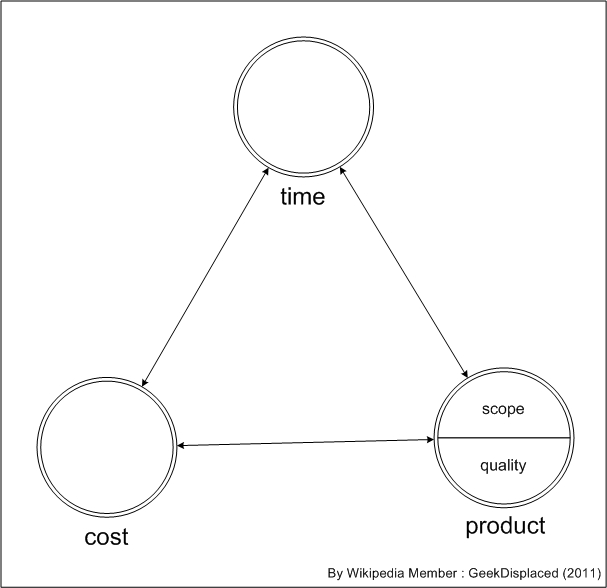
 From time to time, the Population Health Blog likes to refer to this article on the "iron triangle" of health care reform. Using classic project management theory, it suggests health care planning is:
 a) bound by 1) cost, 2) quality and 3) access, and
b) if there are limited resources, health system planners can only optimize two out of three.
Want to decrease costs? Either quality will go down or access to care will decline.
Want to increase access? Docs and operating rooms will spend less time with patients (quality will suffer) or costs will go up, because you have to hire more docs or build more operating rooms.
Suppose you want to increase quality? Because most interventions that increase quality are not free, it'll cost you. Alternatively, fixed budgets and resources will have to be tasked to additional needs, so access will suffer.
It's admittedly simplistic, but this framework can be used even by the amateurs in the White House to better define the Veteran Affairs scandal. As the PHB understands it, VA administrators wanted to increase quality (more primary care, better mental health services), but they didn't have the budget to match it. Access declined and, voila, waiting lists developed.
Which brings the PHB to the insurers' dilemma. The generous narrative is that commercial and government insurers can leverage "quality" and somehow increase access for more persons with insurance and/or "bend the curve" of cost inflation. The "iron triangle" says that's not true and the PHB agrees.
That's because:
1) while it's possible to statistically assess outcomes in primary care settings, there is a shortage of primary care providers.
2) it's far more difficult to statistically assess outcomes in specialty settings, where there are limited numbers of patients, fewer commonly accepted outcomes and a greater impact of patient variation.
In other words, quality is neutralized. That means health care is a two sided triangle.
Assuming quality is now constant, the PHB now has another reason to predict that insurers will have only two options in 2015:
1) increase access to care for more persons, but that means increasing, not decreasing costs. That means higher out-of-pocket costs for patients, or lower reimbursement for providers.
2) lower costs, but that means decreased access to care. Providers will refuse to contract or more restricted provider networks be created.
Image from Wikipedia