Leaderboard
728x15
Showing posts with label Obamacare. Show all posts

The Oval Office Tone At the Top and the Temptation for Consumers to Lie About Income on the Health Insurance Exchanges

According to this CNN article, it's naïve for the Disease Management Care Blog to expect U.S. Presidents to never lie. From time to time, political realities force occupants of the Oval Office to use falsehoods to advance a greater good and/or protect the integrity of their office.  What's more, when they're found out, voters tend to be remarkably forgiving. So, When Mr. Obama repeatedly reassured Americans that "you can keep your health insurance," the DMCB should conclude that this was business-as-usual statecraft and that it will all work out.

But even if many Americans sign up for health insurance and the President rebuilds his approval ratings, the contrarian DMCB has a deeper concern.

It thinks a dishonest "tone at the top" can have a corrosive effect on how Americans will access their premium subsidies. 

In the business world, it is well known that the misbehavior of corporate boards and C-suite leaders can infect an entire company. The Board Chair's or the CEO's dubious financials, revenue schemes, stock manipulation, predatory behavior or just plain arrogance can roll right through the managerial ranks and destroy a company in a matter of months. When leaders lie to serve some other business need, you can be sure that others in the company will also lie.

The same may be true for the government of the United States. It's one thing to lie about Japan's military might (Roosevelt), trading arms for hostages (Reagan) or Iraq's weapons of mass destruction (Bush), it's quite another to lie about buying health insurance. The DMCB suspects that "tone of the Oval Office" is subtly signaling to regulators, insurers and ultimately consumers that it's OK to manipulate the truth when it comes to buying health insurance.

Recall that as part of health reform, the health insurance exchanges prompt applicants to estimate future income. It's also temptingly easy to misrepresent projected 2015 income.  A mild "fudge" that lowballs income can make the difference of thousands of dollars in subsidies.

Long before the President landed in hot water over his "you can keep it" promise, Americans had a huge incentive to lie about their income. That has been especially true for low income earners who really need the insurance. Now that everyone - including Mr. Obama - has admitted that he stretched the truth, the DMCB suspects Americans now have one more reason to do the same when it comes to getting health insurance subsidies. Once that pattern of insurance fraud becomes established in the marketplace, the DMCB thinks it will never go away and hundreds of millions of dollars will go to where it's not intended year after year after year.

The DMCB predicts tens of thousands of Americans who purchase insurance on the exchanges will succumb to lying in 2015.

You read it here first. 

Coda: The good news is that when it comes to the health insurers who are responsible for signing up the millions of Americans, there's no evidence that they're helping enrollees lie.  The DMCB suspects that in the battle to capture market share, it's just a matter of time until one of them has a renegade employee or two who channel the President and likewise help prospective customers to lie. We'll see.

Whither Obamacare, Now That "It's the Law of the Land?"


While a roll-back of Obamacare now is about as likely as spotting gargoyle statuettes among the DMCB spouse's holiday decor, a recent New England Journal article points out that the Affordable Care Act (ACA) - even if it is the law of the land - still has a very bumpy road ahead.

That's because of four key issues:

1. The States can still knot things up by forcing Washington DC to run the Health Insurance Exchanges (HIEs).  It's very possible that Uncle Sam won't pull them off on time and, what's more, there's a credible Supreme Court challenge looming over Obamacare's potential lapse in extending tax credits to the federally-run HIEs.

2. States can refuse the Medicaid expansion. While their statewide hospital associations are very  unhappy about that, Governors are either ideologically opposed or just plain wary of additional downstream costs. This could result in additional millions of uninsured, especially in the conservative "red" states.

3. Health care cost inflation is likely continue its upward spiral.  Congress, no matter how CMS' payment innovations turn out and no matter how much it wants to curtail costs, is unlikely to withstand the lobbying from all corners of medical-industrial complex involving thousands of pages of rules and regulations.

4. Deep public ambivalence about the law will continue. That means that as Congress and the President look for ways to control the Federal deficit, Obamacare is especially vulnerable. Unlike Social Security or Medicare, the ACA's "patchwork" of insurance reforms is headed toward the fiscal cliff without a strong supportive constituency. Before Congress even touches Medicare, it's far more likely to cut Obamacare. The first hit could be those insurance tax subsidies mentioned above.

Stuff Their Mouths with Gold

The Disease Management Care Blog uncovered this confidential memo, presumably authored by a health insurance CEO to the company's senior management team. Any resemblance to reality or perception is purely intentional.

DATE: November 18, 2015

TO: Senior Management

FROM: The Office of the CEO

RE: Our recent White House meeting on the individual mandate

As many of you are aware, I and other commercial insurance CEOs visited White House to barnstorm over ways to help President Obama out of his latest political pickle.  While, like you, I was caught off-guard by the President's "I hear you loud and clear" proclamation, our trade association CEO, Karen Ignagni, was once again masterful in helping us understand the big picture.  I wish to share that information with you.

1. Remember that the Affordable Care Act (ACA) is a commercial insurance gold-laying goose. Millions of Americans are being forced to buy our products, and a lot of them will be subsidized by the faith and credit of the Federal government. While the President will use every opportunity to deflect any blame on us, we must remember: eye on the prize, people!

2. While we would naturally prefer that, effective January 1 2015, our customers move from the skimpy lower margin individual plans to the richer and more profitable "essential health benefit" plans, Ms. Ignagni anticipated that the amateurs advising the President would lead to him to having to make stuff up on the fly.  Think of this as the price of doing business.
 
3. While many of you will be working long hours through the upcoming holidays to un-disenroll the hundreds of thousands of insureds that got our cancellation nastygrams, let me assure you that getting it right most, not all of the time is our new business mantra.  Sure, thousands of persons will allege that that they thought they were covered with X deductible for Y condition, but we can clean that up after the fact through the standard appeal process.  Hey, it's right there on the White House web site.

4. It's no accident that Ms. Ignagni described our White House meeting as "very productive."  While the details cannot be shared with you, as many of you know, the ACA allows for certain "risk corridor offsets" to be made if there are early death spirals in the mandated minimum benefit plans.  While opponents of the ACA will attempt to undermine those costly offsets in the upcoming government budget battles, we're hopeful that politicians on both sides of the aisle will ultimately recognize that it's not our fault that the White House's insights on health insurance is about as deep as Toronto Mayor Rob Ford's awareness of the perils of crack.

5. We must remain quiet and outside the public eye. While all of us are appalled at the Administration's blunders, the last thing we want to do is to remind our Democratic allies about the "public option."  If we are approached by the media, let's recall that Aneurin Bevan, the founder of the National Health Service, neutralized the opposition of Britain's doctors by "stuff[ing] their mouths with gold." The ACA is our gold and let's keep our dismay out of sight and our mouths silent. 

Rising Healthcare Costs: Delayed or Defeated?

Ready, set......
According to this just-published New England Journal article, analysts are still waiting for the twin forces of 1) an improving U.S. economy and 2) higher numbers of newly insured Americans to reignite healthcare inflation.  While the latest data from the Bureau of Economic Analysis (BEA) are conflicting, data from the early part of 2015 suggests that health costs are remaining tame.

What gives?
 
While many Obamacare supporters say this is more evidence of Washington's central-planning genius, author Charles Roehrig notes other factors be at play, namely:

1. The 9 million of 2015's newly insured amounts to 3% of the U.S. population. Their baseline spending was probably half of normal, so the resulting increase would expand the nation's spending by a modest additional 1.5%.  Since this group is younger, it'll likely be less than that.  Their contribution to increasing costs will be harder to detect.

2. What's more, insurance enrollments were finalized relatively late in the year, so these newly insured haven't had much of a chance to give their new benefits an early test-drive.

3. The first quarter of 2015 was an unusually cold winter. The Population Health Blog recalls how freezing temps, wind and snow made for a relaxed day at the clinic. Multiply that across millions of newly as well as long-term insured people, and it adds up.

4. Yes, stupid, it is the economy, which has a strong correlation with healthcare spending. Loss of health insurance thanks to unemployment, declining tax revenues that pressure government insurance programs to limit eligibility as well as benefits, employers' unwillingness to go along with otherwise automatic benefit increases and a general unwillingness of consumers to open their wallets in recessionary times has also added up.

5. Thanks to the expiration of some patents, prescription drug spending moderated.

Bottom line: all of the above are one-time impacts.  The economy's impact and new access to insurance are lasting fundamentals that will not go away. It's too soon to tell what is really going on.
 
The PHB will stay tuned.

The Magnificent Carnac Again Speaks to Health Care Reform!

Visitated once again by the astral, magnificent, all-knowing and soothsaying Carnac, the Disease Management Care Blog has divined his answers to the questions swirling around the healthcare.com roll-out debacle.

As Tonight Show Johnny Carson fans know, the prescient Carnac can foretell answers before the questions have even been asked by Congress and its allies in the punditosphere! By merely holding an hermetically sealed envelope containing the question, the mighty Carnac would provide astounded observers with the answer.

Behold the wisdom of Carnac's answers:

"Six"....

That is NOT the number of individuals securing insurance on the first day of the website! Rather, it is the answer to the question:

"How many million lines of computer code need to be changed to fix the Healthcare.gov web site?"

"Healthcare dot gov and the DMCB spouse"....

The question: "Name one thing that won't work and one person who won't twerk."

"Grits, Glitz and Glitch"....

The question: "Name an excuse for breakfast, zirconium and a government sponsored website."

"Burger King, Viagra dot com and the misstatements surrounding the Affordable Care Act"....

The question: "Name three homes for "The Whopper."

"Zero Dark Thirty"....

The question: "Name three descriptions of what happened to President Obama's approval ratings following the roll out of healthcare.com."

More information on the image can be found here.

The Health Wonk Review: An Example of the Facts, Education and Spin Behind the Lingering Debate on Obamacare and Health Reform

 
Modern political discourse
The Disease Management Care Blog had a Hurricane Sandy choice: either a) leave day before that early A.M. hospital procedure and stay with friends who live close by, or b) stay at home and make the long trip in the wind and the rain to the hospital that same morning.  The DMCB spouse turned to repetitive education to help the DMCB make the right choice.

Does that learning tactic underlie Obamacare supporter Maggie Mahar's approach to the latest Health Wonk Review?  That's what the DMCB thought when it read Maggie's posting.

To help the thousands of health reform realists who make up the DMCB readership, Hurricane Maggie repetitively retreads the cost-control talking points from reform architect Peter Orszag, surgeon Golden Boy Atul Gawande and the White House Office of Management and Budget  Rest assured, says Maggie, if you selectively counter the DMCB's fiction with facts, you'll realize Washington DC's solutions are the right choice.

The DMCB isn't too sure about that.

Maggie doesn't argue health care costs aren't rising, only that the increases are less than widely claimed.  She credits Obamacare.  The Disease Management Care Blog agrees that cost trends are moderating, but it also credits a lackluster economy.

Maggie says be of good cheer, because the increased costs are delivering correspondingly better value for the health care dollar. The DMCB says value remains an inexact science that is ill-suited to simplistic nostrums and blunt force laws and regulations. The latest examples of this conundrum include mammograms and annual check ups.  There are plenty of others like this.

Maggie points to Massachusetts's Atul Gawande's brimming optimism about Massachusetts leading the way with risk and performance contracting as a cost-control panacea.  The DMCB awaits the arrival of hard macroeconomic outcomes data that proves the experiment works.  It also points out that the Bay State's recently passed cost control legislation speaks volumes on what that state's leaders really think about the savings-success of Romneycare.

Last but not least, not everyone on the blue side of political spectrum shares Maggie's optimism.

By the way, the DMCB has received a cost estimate from the unnamed hospital mentioned above. That institution is the flagship part of a nationally recognized integrated delivery system that is a basis for much of Maggie Mahar's enthusiasm. The DMCB's planned procedure coupled with OR charges and an overnight stay will result in charges, prior to discounts and contracted rates, in excess of $100,000.

For those of us with a lingering doubt that our political class's health reform sound-bites, nostrums, talking points and pronouncements will cut through all those inconvenient facts, the DMCB recommends this catchy tune.  You'll feel a lot better:


Image from Wikipedia

The Dreaded Strike Three for Obamacare: Corrupted Exchange Data and Inaccurate Insurance Policies

While the prescient Disease Management Care Blog was among the earliest to identify the threat of an Obamacare-induced insurance "death spiral," it missed spotting the potential fallout from a delay of the individual mandate.

As shrewdly pointed out in this Politico article, health insurance timelines require at least three months of claims experience to inform future rate setting.  Once that actuarial work is done, it then has to go through the states' Insurance Departments for approval.

In other words, if large numbers of Obamacare customers are allowed to sign up after March 31, 2015, insurance companies won't know what to charge their customers on January 1, 2015. 

While overcharging can be remedied by customer rebates, it remains to be seen how accommodating Washington DC will be if the insurers undercharge. That means negative cash flows, raiding surpluses and facing the ire of their investors and Boards of Directors.

It's baseball season, so think of the death spiral as a potential strike one, and inaccurate rate setting as a potential strike two.

Which brings the DMCB to a dreaded strike three. If it happens, the health reform brand could be irretrievably tarnished.  It could also and sink the current version of Obamacare.

Strike three would be a critical mass of inaccurate insurance policies.

If reports like this and this are even remotely representative of the back-end of Obamacare enrollment, the relative trickle of individuals who are successfully navigating the exchanges are getting commercial polices that depend on a very vulnerable reconciliation process involving many moving parts.  That includes information from the "hub" as well as user-based data entry. As noted in this report, commercial insurers are being forced to manually "clean up" the information prior to issuing their exchange-generated policies.

The DMCB suspects that a "garbage in, garbage out" adage may apply. Thanks to sheer number of inputs, clean-up mistakes are going to be inevitable.  And it will get a whole lot worse if the healthcare.gov web site gets only partially fixed. 

While a few mistakes are acceptable in large risk pools, more than a few could be huge problem at three levels:

1. At a business level, where a core competency of insurance companies is to cover their enrollees and only their enrollees. Insurance companies are really good at knowing who is and who isn't insured for a covered or non-covered service with or without a variety of co-insurance arrangements.  It's more than just getting it right, it goes to the core of their business model. If enough policies are inaccurate, it could bring the finances of some smaller health insurers to their knees.

2. At national health policy-making level, where a critical mass of insured customers with premiums and subsidies mismatched to the risk could destabilize the market and distract our political leaders. Think about the customers who assume a service is covered, providers who expect to get paid accurately, balance sheets that don't reflect the truth about claims expense as well as IBNR and regulators who will need to sort it all out.

3. At an Obamacare "brand" level.  Think about all those unfriendly and anecdotal news reports about vulnerable patients who ended up legitimately - if mistakenly - paying more out of pocket for care, or persons mysteriously lacking insurance, or hospitals and doctors being unable to get paid. It could ultimately track back to the HealthCare.gov web site that everyone will loves to hate.

The worst part is that the White House has done such a masterful job of bullying the insurers that it's unlikely that they'll want to rock the boat by going public with any notification that their enrollment data is corrupted.  Mr. Obama will naturally claim that he wasn't in the loop and his loyal aides will deflect blame elsewhere.

Strike three, and we may not even see it coming.

The President Says You Should Ignore This Health Wonk Review

Welcome to this October 2015 edition of the Health Wonk Review, hosted by your Disease Management Care Blog. The Review is a sampling of the best recent postings by thoughtful health policy bloggers who are offering insights about healthcare delivery, insurance and reform that are outside the media mainstream.

Or White House control. While Mr. Obama would like the bloggers to sit down, be quiet and let the Washington's expert political class get on with the people's work, the DMCB respectfully disagrees. It was the bloggers who were sounding the earliest alarms about the dysfunctions of the federal health insurance exchange. Despite the advice of our President, this edition of the HWR proudly offers readers some important insights, additional warnings and lessons learned.

One of those lessons is that the HWR bloggers should be read more, not less.

Of course, this Review is not just about the exchanges. If that bungled bit of bureaucracy doesn't pique your interest, read on and you'll find other great stuff on health reform, pharmaceutical costs, Medicare's well-meaning ability to impose silly regulations on docs and how that horrific Bangladesh garment factory fire didn't really lead to any meaningful worker safety reforms.

First up, the exchanges.....

Joe Paduda of Managed Care Matters says the Obama Administration's roll out of the exchanges failed at several levels. Let's face it, he says, the development process was politicized and, as a result, consumers were given the green light to use a flawed web site. They're now being forced to enter too much data before they can shop for insurance, server capacity is insufficient, links to participating insurers are dodgy and patients are unable to ascertain if their doctor is in a particular network. He believes the best way forward is to completely redo the web site and to never ever forget what happens when politics trumps common sense. It's so bad, says Paduda, that the only reason not to fire HHS Secretary Sebelius is the prospect of another partisan battle over her replacement. "Ouch!" says the DMCB.

For crying out loud, says Tim Jost in the Health Affairs blog notes, we're talking about a web site, not cold fusion. While all eyes are on the individual mandate, Jost isn't worried because that's assessed on a monthly basis and the ACA allows for "hardship" exemptions. He reminds us that the key deadline date of December 15 is months away. That's the last day that individuals can enroll in time for the subsidies that will be in place on January 1 2015. If deadline is not met, it's possible that millions of Americans will be unable to obtain affordable insurance. The good news is that the Feds have broad discretion to extend enrollment periods as well as provide commercial insurers with additional assistance. Jost is confident that with the right amount of creativity, health reform can continue. After reading this, the DMCB predicts HHS's creativity will include delaying the individual mandate without "delaying" the individual mandate.

John Goodman is less optimistic. He uses his eponymously named blog to remind us that if only the sickest and most persistent Americans successfully use the exchanges, Obamacare may precipitate numerous insurer death spirals. State risk pools are closing, employer-based plans are closing, and individuals can now exit their "job lock." John predicts the sickest of these individuals will find the exchange's "gold" and "platinum" insurance plans to be relative bargains. Goodman offers some potential solutions, including flattening the subsidies, prohibiting dumping of the sickest members by insurers, requiring COBRA benefits to be exhausted first and stopping enrollees from gaming the system by enrolling at the last minute. It's the risk pools stupid!

Sean McGuire of Health Reform Explained coins the new catchphrase "nerd herd" to describe the exchange's "tech surge" repair. Despite the impressive-sounding term, he doubts the website code will be successfully rewritten any time soon. He wonders if the Feds shouldn't completely outsource to the states, because they have the track record and, with sufficient financial support, the resources to fix this problem. Code woes prompt geek fleet.

Hank Stern of the Insure Blog builds off another blogger's observation that one reason why the exchanges are not performing well is because HHS wanted to shield users from seeing the cost of their insurance prior to the calculation of the income-indexed subsidy. For us wannabe techies, this is known as a "no wrong door" approach to web portals. What HWR review is complete without a catch phrase you can use to impress your friends and stymie your enemies. And you're welcome.

So, how's health reform going?

Louse Norris, writing in Colorado Health Insurance Insider blogs with first-hand knowledge about a wrinkle in the ACA that allows for early renewal of existing insurance policies. As the DMCB understands it, this pushes back the day of reckoning when persons have to "buy up" to standard insurance benefit packages that may be more expensive than the "skinnier" policies that have lower out-of-pocket expenses. While some unnamed policy makers think that's a loophole, Louise thinks it's a good idea because, for her family - and many other Americans - that translates into hundreds of dollars a month in savings for 2015. What other loopholes are there?

Maggie Mahar of the Health Beat Blog points out that the commercial insurers were at the table when the final details of the Affordable Care Act were hammered out. They agreed to shelling out new
fees and taxes to help fund the legislation. Despite that, however, skeptics were suspicious that Mr. Obama had been too accommodating to the insurers. According to Maggie, we now can say with certainty that the skeptics were wrong. The commercial insurers' stock prices are now tanking because the investors are only now discovering, among other things, that pre-existing conditions cannot be used against patients, administrative costs are limited, preventive care now has first dollar coverage, lifetime caps no long exist, that they have to cover a standard benefit and state regulators are finally "getting some spine." She thinks the investors made two mistakes that she perceptively avoided: along with Ms. Pelosi, they didn't read the bill and they were confident that Mr. Obama wouldn't be re-elected. The DMCB wonders if investors are also worried about the commercial for-profits being battered by death spirals.

Never mind high tech, how about payment reform leading to high touch? David Harlow of The Health Blawg argues that the evidence that transformed primary care can save money is reaching critical mass. Primary care clinics that invest in systems of care may cost more in the short run, but the downstream cost savings are considerable. As fee-for-service continues to unravel, Harlow predicts these preventive and care coordination business models will become even more compelling. Which prompts the DMCB to provocatively ask if this could this also be an argument for the monthly fees commanded by the "concierge" practices?

For those of us who think there may be market solutions that can reinvigorate medical education, Roy Poses of the Healthcare Renewal blog says it's time to think again. Roy looks at some of the "outcomes" from one off-shore for-profit medical school that caters to U.S. students, including the entry of venture capitalists, the creation of shady tax shelters, deans with jet-setting lifestyles, Swiss bank accounts, laundering money and the mysterious disappearance of school Presidents once the indictments start to roll. As Roy has pointed out, however, on-shore and not-for-profit medical enterprises are not immune from bad behavior either. Health care bubble, anyone? 

Brad Flansbaum of The Hospital Leader blog examines the impact of the Medicare regulation that post-hospital home health services can only be prescribed during the course of a "face-to-face" visit. For doctors getting their patients out of the hospital, this has resulted in one more form that needs to be completed (typically by someone other than the doctor) and then signed (by the doctor).When added to the press of other things that have to happen, the result is a discharge of a thousand cuts. The DMCB's colleagues have lived with these and other unpleasantness that comes from being on the business end of Medicare.  And people wonder why docs are leery about a single payer system?

Drugs!

Jason Shafrin of the Healthcare Economist blog describes how the Italian city of Naples recently saved 20 million euros in pharmaceutical costs. There was no single solution, but a combination approaches that may hold lessons for the United States. They include direct purchasing of drugs by patients, providing a supply of necessary medicines when patients leave the hospital, accepting generic drug names for prescriptions and making patients pay the difference when they insist on a brand-name drug. That doesn't mean that Italy's cost problems are automatically solved. New agents are constantly coming on line and the Italians do recognize that manufacturers need to recoup their development costs. That's OK, however, because Italy uses multiple administrative levels of review for efficacy, a rigorous "pay for performance evaluation process and "soft" spending global limits. In the end, if a drug is worth it, they'll pay for it. U.S. drug company executives may end up taking some of their own products if this system gets adopted here.

If reports are true, David Williams of the Health Business Blog points out that the Food and Drug Administration's public service mission is being undercut by the "invitation-only" meddling of pharmaceutical companies in the Agency's pain management evaluation meeting panels. Either pharma should get out, says Williams, or other legitimate stakeholders, like patients, payers, academics, advocacy groups and other government agencies should also be in the room. So, with news like this, why is bloggery a bad thing?

And last but certainly not least.....

We all remember that horrendous garment factory fire in Bangladesh that killed over a thousand workers. If you still enjoy wearing that name-brand clothing, you won't want to read Julie Ferguson's summary and review of a multi-part series of articles on the topic appearing in Workers Comp Insider. If you do, you'll either want to go naked or start paying attention to which retailers have truly committed to international worker safety. Unfortunately, it appears that most continue to put low-cost fashion as their number one priority, even if it means putting more lives at risk. Behold the health implications of our throw-away clothing life style.  Maybe it's time to reward clothing manufacturers that offer products made in the U.S.A. 

Access, Affordability and Quality: Only A Third of the Work Is Done

Access, affordability, quality
Did you know that the taxpayer costs of some versions of public transportation have proven so expensive, that it would have been cheaper to provide each rider with their own BMW

Which is why the Disease Management Care Blog, which always uses public transportation in and out of the SFO, ORD, ATL, PHL airports, ascertained that it was time for it to make its coupe selection. Unknown to the DMCB spouse, it has started to examine the trade-offs between bimmer cost, speed and comfort.

Which reminds the DMCB of the parallel universe of health care.

In its travels around Washington DC, the Disease Management Care Blog has repeatedly heard that the health reform likewise involves trade-offs between the three similar goals of 1) access, 2) affordability or 3) quality. Historically, most health reform proposals have managed to secure two out of three. A good summary of the historical travails of this "iron triangle" can be found here.

Which is why conservative-leaning Gail Wilensky's examination of Obamacare in the Oct 18 issue of the New England Journal makes for good reading. She finds the President's signature achievement wanting because it only delivers on on the single goal of access. 

Thanks to the law, 30 million Americans will soon be able to get coverage.  Approximately half will obtain subsidized private insurance  and the other half will be able to qualify for Medicaid. 

All well and good, except a substantial proportion of Americans remain philosophically skeptical of the law's merits. Whether you agree with the skeptics or not, it's still feeding a lingering partisan divide that continues to chew up precious political capital.

And, according to Ms. Wilensky, that was the easy part. Affordability and quality remain serious challenges.

That's because, despite some promising (but ultimately still unproven) innovations involving bundled payments and shared risk, Obamacare leaves Medicare's fee-for service reimbursement very much intact for years to come.  That means quality will continue to disappoint and costs (i.e. affordability) will take a greater and greater share of America's gross domestic product.

Disagree?  While Ms. Wilensky may be criticized by partisans as a market-oriented Republican shill, the DMCB has seen her up close, in-person and in action: she's smart, always makes good points and when she speaks about the Affordable Care Act, the rest of us should listen:

1) Some of the anticipated savings of Obamacare that went into budget planning included a curious item called "productivity adjustments."  This was based on the assumption that the health system would achieve greater efficiencies long before any of the Affordable Care Acts payment innovations are a) proven and b) imposed on the majority of providers.

2) The Relative Based Value Scale is fundamentally untouched and continues to reward physicians for high margin services instead of efficiency.

3) The much ballyhooed value-based payment bonuses are quite modest and an unlikely to significantly alter hospitals' approach to doing business.

4) Congress' past vulnerability to special interests and the low likelihood that the Independent Payment Advisory Board will change physician behavior does not inspire confidence.

5) While supporters believe the law will incent value-driven market behaviors, it's ultimately Washington DC - not consumers and certainly not markets - that will reward the winners and losers.

6)  The prospects surrounding the looming fiscal cliff and SGR remind us that cutting fees are not the same as cutting costs.

One third full versus two thirds empty?  Perhaps.  Depressing?  Maybe.  An accurate portrayal of bad times to come?  Maybe not.  Better, says the DMCB to know what we're potentially up against and the hard choices we still have to make between affordability, quality and access.

Addendum:  If you got here thanks to Maggie Mahar's Health Wonk Review, a friendly rebuttal to her partisan spin can be found here.  The DMCB linked that up on the Reply part of the HWR posting but it's gone missing.

The Progressives' Point of View When It Comes to Health Reform

While the Disease Management Care Blog tries to be an equal opportunity cynic and generally sides with policy underdogs and lost causes, it supposes that its conservative leanings sometimes comes through in its writing. 

That was enough to prompt a series of well-written email exchanges with Greg Brown, a retired educator from the Kansas City area. He did a great job of compactly summarizing the views of supporters of the current version of health reform. 

It seems to boil down to five main arguments:

1. Medicare and Social Security: While passage of these landmark safety net programs was likewise met with deep concerns about the erosion of liberty, their ultimate success cannot be denied.  Most of the persons who are against the Affordable Care Act are ironically happy to have the feds appropriate a portion of their income in exchange for economic security in their old age. They can't have it both ways.

2. This is not buying shoes:  One role of the federal government is to step in when markets fail, and that has been amply demonstrated when it comes to health insurance. While it's difficult enough to remember to even buy a product that you may not need, shopping for the best value in commercial insurance is practically impossible.  Proposals to expand this unworkable solution are a pipedream.

3. The public good: Keeping people from going bankrupt in the course of an unexpected illness is everyone's interest.  It's ultimately a better bargain for society to proactively manage this with near-universal insurance than to deal with poverty after the fact.

4. Purchasing power: To date, Washington DC has chosen to not flex its purchasing power with providers.  Think of how much cheaper drugs would be if Medicare leveraged this for Part D.  Just wait until the happens in the rest of health care system and how much all of us will all benefit. 

4. Status quo: Even if you don't accept the track record of Medicare, the realities of buying insurance, the merits of a public good and the advantages of purchasing power, the status quo has led the U.S., compared to the rest of the developed world, to be a unsustainable per-capita cost outlier.  Something has to change. and theACA is doing just that.

I am not an expert by any stretch. I am just an interested layman. I really wish Obama had pushed for a single payer or at least a strong government alternative delivery system. But here we are and as imperfect as it is, it is the best thing I see on the horizon right now. It does at least attempt some cost controls, it broadens access, and it may lead to better quality with a focus on health outcomes rather than billable procedures. At least it attempts to address all three.

Image from Wikipedia

The High Price of High Deductible Plans and the Potential Role of Population Health Management

Your bronze plan ticket to health care?
Should patients be forced to reach a spending threshold before their insurance kicks in? At first glance, it makes sense, because health consumers' "skin in the game" forces them to think twice before going to the emergency room for a sore throat, or an orthopedic surgeon for simple back pain.

Wharam and colleagues examine the science behind high deductible insurance in this just-written article in the New England Journal.

And the science says there is a lot we do not know.

Once insurance risk is monetized into premiums, policymakers as well as insurers are operating in the dark about calculating the right deduction for a given income level. One example is Cover Oregon's $5000 deductible for persons who are at 200% to 400% of the federal poverty level. That means a family with a yearly income as low as $47,000 would have to spend more than 10% of their income on health care before seeing a dime of insurance coverage.

"Egads," says the DMCB.

Given that stark reality, the challenge is to figure out how an up-front deductible influences "buying behavior" once persons get sick. Unfortunately, most of the research out there is on the impact of relatively "small" amounts of out-of-pocket expenses on health care utilization, especially in low-income populations. The bad news is that lay-persons - who are unable to discern the difference between a simple headache vs. a brain tumor - tend to "indiscriminately" lower all utilization as their cost sharing goes up.

There has also been no research on the impact of high deductible plans on mortality or chronic condition control.

Concluding that the U.S. is "poorly prepared" for what will happen under Obamacare's bronze high deductible plans, Wharam et al recommend there be more research on the topic.  Pending that, they suggest consumers be educated about their insurance purchases and be encouraged to chose low-deductible plans. They note that the star-crossed insurance exchanges (once they're fixed) can be configured to help do that. When there is employer-based insurance, employers could be encouraged to make the deductibles more proportional to income. In addition, health savings accounts could also help.

While the authors don't use the words "population health management," they tap this discipline as one solution to this Obamacare problem. They point out that predictive modeling/risk stratification can be used to create "personalized" insurance designs that optimize high-risk patients' access to care. Patients in these plans could have access to decision-aids and coaching that help them figure out when it's a simple headache and then they should seek medical care.

The Health Insurance Death Spiral: Is High Health Insurance Exchange Use An Early Symptom?

According to the White House, the health insurance exchange glitches are a symptom of high demand from a grateful citizenry eager to embrace Obamacare. While articles like this and this suggest that sloppy and amateurish programming is really behind the website crashes, the Disease Management Care Blog is concerned that early high demand - if it exists - could be an early sign of a coming insurance death spiral.

"Death spirals" occur when persons with high levels of risk disproportionately enter an insured population.  When that happens, premiums have to rise to match the increased expenses. That, in turn, causes persons with lower risk to drop their insurance, leading to an even higher proportion of high risk individuals, who drive prices even higher.

The DMCB intuitively doubts that the early high demand described by the White House is the result of healthy latte-sipping millenials and young invincibles having nothing better to do with their web-surfing time.  Rather, the persons most likely to be in a rush to get into the web site are persons who really need insurance.  Those would be the ones facing huge health care bills.
 
Another indication is the relative lack of the standard individual anecdote or "ledes" in media reports that hook the reader into paying attention.  Used by politicians and journalists alike, ledes put a "human face" on a narrative by bridging the personal and the policy.   

Supporters of exchanges would probably like to see something ledes along the lines of...

For years, 25 year old Ivanna Ceeadoc could only lurk outside the local health clinic and watch helplessly as her friends from the coffee shop down the street got free health communications from the nurse practitioners within.  But after using the health insurance exchange....

or

Until he signed up in the health insurance exchange, part-time jazz drummer and retail specialist Hank Erinfersumburgers never had to see a health care provider. Previously unaware of a bleak future of fast food and tight clothes, Hank's zero dollar co-pay now lets him see a dietician and have enough money left over for a lunch......

Young Ivanna and Hank haven't made an appearance in the national health insurance exchange narrative because they probably aren't part of the story.  More likely, it's persons in their 50's and early 60's who have been hold they need a joint replacement, an angioplasty or back surgery....

 Ima Medeesazter was looking at a stack of medical bills a mile high.  Her surgeons' plans included weeks in a hospital costing her hundreds of thousands of dollars. Ima put things off, but now that she used the exchange, she can look forward to getting to know her ICU nurses really well.......

Even more worrisome: this astonishing statement by HHS Administrator Kathleen Sebelius that she "doesn't know" how many have enrolled in health insurance since the October 1 opening date.  If the experts running the shop are unaware the Insurance 101 principle of knowing who and why persons are signing up for health insurance, they have no idea about the spiral threat.

Image from Wikipedia

Let Them Eat Cake: Stepping Outside the Health Care Reform Comfort Zone

How would Ms. Antoinette
ponder health reform
with her advisors?
While commonly attributed to Marie Antoinette, the phrase may actually be testimony to Jean Jacque Rousseau's genius in using four words to capture an elites' inability to grasp the plight of a struggling underclass.  For a more modern depiction of a lifestyle bubble, think of the 1% not getting just how difficult it can be to make a living wage.

And it's not just the 1%. African Americans, with some justification, note that whites have yet to grasp "the set of experiences and a history" that perpetuates racial inequality. It's not just the "facts" but how facts are sorted, prioritized and interpreted by a brain wired by decades of being surrounded by like-minded people caught up in their information loops.

But it cuts both ways. When confronted by the hostility of tens of millions of Americans to the Affordable Care Act, liberal-progressives likewise respond with similar puzzlement. Who can blame them for rationalizing things with attempts to provide more "education" or blaming it all on obstinate Tea Bagger and "Birther" wackiness?

It's not that simple.  As pointed out in this The Atlantic article, conservative skepticism about the size, regulatory reach and spending of government was well underway long before Mr. Obama set foot in the White House.  Focus groups have little trouble finding deeply held opposition to expanding government entitlements, middle class dependency, pro-business globalization, wealth transfers and scary levels of deficit spending. Given the big picture,  Obamacare is less of a problem than a symptom

As result, even if the White House and its Democratic allies prevail on the shutdown showdown, successfully raise the October 17 debt ceiling, cancel the January 1 2015 sequester and take back the House in November 2015, the opposition to the health care law isn't going to simply fade away.

But, say my liberal friends.....

1. Much of the Affordable Care Act is based on Republican ideas, including the mandate and Romneycare.

The mandate and Romneycare were never intended to be imposed nationally, but adapted by each of the states. 

2.  It will save money.

Health care consumption declined before the passage of the Affordable Care Act. Experts legitimately disagree on the impact on future health care costs but it stands to reason that more people with insurance will lead to increased demand and higher spending..

3.  The health care system is broken

Actually, the part of the system that was broken was the individual insurance market.  This objective OECD Report summary points out that, compared to many other developed countries, U.S. quality has been quite good and our cost trends are lower.  And while it's too early to tell, the health insurance exchanges travails combined with multiple other self-inflicted wounds suggest that the cure may end up being worse than the disease.

The point here isn't who's wrong or who's right.  Rather, it's clear that skepticism over Obamacare's ability to deliver on all its promises is not crazy.  Its critics not only deserve their time in the public square but to have their preferences reflected in policy and legislation..

What's more, the Obamacare dust-up is part of a bigger concern over the expanding role of government that tens of millions of Americans find potentially intrusive and unaffordable.  The inability of the DMCB's liberal progressive colleagues to comprehend that may be a less a function of their superior intellect or the stupidity of the opposition than an Antoinette-esque inability to step outside their familiar biases and ponder a different point of view. 

Valuable Personal, Political and Health Reform Lessons, Courtesy of the Federal Government Shutdown

Coming to consensus
the old fashioned way
The Disease Management Care Blog views the federal government shutdown with the same morbid fascination of watching personal injury lawyers justify their double digit malpractice suit contingency fees: it's so awful, it's hard to look away.

The good news is that that doesn't mean that the shutdown doesn't hold some important personal and political lessons.  They can make DMCB readers better citizens and our political class a credit to our Republic. 

To wit......

When the DMCB spouse expresses consternation over the boneheaded actions of her husband, the DMCB can now respond by:

1. changing the subject,
2. retreating to the DMCB World Headquarters and blogging about the spouse's unreasonableness,
3. referring to the alleged lapse as a "glitch."

Things don't go well in the opening day of a widely anticipated unveiling of the largest health care achievement in the history of the United States.  If you were in charge, you would respond to the health insurance exchange breakdown by:

1. recognizing the problem and promising to fix it,
2. reminding the public about the painful gap between lofty campaign promises and disappointing bureaucratic reality,
3. shrewdly drawing flattering comparisons to Apple, the most widely admired brand in the world.

As the leader of a political coalition, you are stymied by the division of powers in the world's longest lasting democracy.  In response you:

1. seek consensus
2. deploy ad hominem attacks in press conferences
3. offer to compromise by allowing the opposition to do things your way.

Wanting to be an informed member of the electorate, you regularly watch either CNN, FOX News, MSNBC, PBS, CBS, NBC or ABC because:

1. These broadcasts' news editors subtly frame their closed information loops to meet your own political biases,
2. You haven't discovered BBC or Al Jazeera
3. There aren't any movies on TV featuring svelte vixen vampire babes having their way with their mesmerized male victims.

By pointing out that Obamacare is "the law of the land," you are really saying:

1. Our representative democracy passed legislation that was signed by the President and upheld by the Supreme Court, so get over it,
2. Now wait a minute, our representative democracy can modify or even roll back health care laws.
3. Enough with the debate, time to move on and figure out how to make preschool education, low interest mortgages and low-fat frozen yogurt protected federal entitlements.

Being a Game of Thrones fan, you wonder if the following might not be useful in settling the budget impasse:

1. Asking what the honorable Ned Stark would do, until you recall that he was beheaded.
2. Invite the opposition to a Red Wedding
3. Call up your elected representative and say "Hodor!"
4. Call up your elected representative and hear him or her say "Hodor!"

Everything You Need to Know About Health Care Reform, Thanks to a 25 Minute Video, Courtesy of Managed Care Magazine

Thanks to Managed Care Magazine, the Disease Management Care Blog can post this interesting 25 minute interview with Princeton healthcare economist Uwe Reindardt.  Suitable for desk-bound meal-break viewing by overachieving DMCB readers, the modest and insightful Dr. Reindardt gets it mostly right:

No, the slowdown in the U.S. rate of health care costs cannot be ascribed to passage of the Affordable Care Act.  It started wayyyy before Obamacare was passed and is more likely due to the economic slowdown and increased consumer cost-sharing.

Accountable Care Organizations remain an "iffy" experimental proposition because they "don't go all the way like Kaiser."

Republican proposals to let health insurers sell their products across state lines are hardly a health reform panacea, because prices (and therefore premiums) are not a function of where the insurer is domiciled, but where the care is rendered.  Texas insurers would still have to pay New York prices.

Americans use fewer pills, occupy less bed-days and see fewer doctors, but we pay more because providers can charge more.  Despite being relatively small vs. the behemoths like Aetna and Cigna, regional hospitals have considerable market power that translates into take-it-or-leave it local single seller monopsonies.   Europeans, in contrast, have lower prices because their system is dominated by single purchaser monopolies.

We're headed toward a three-tier system comprised of 1) the indigent safety-net public programs, 2) the middle class "reference pricing" "networks" where consumers pay the difference if they want to buy up and 3) "boutique" health care for the 5%.

There's reason to be optimistic about the next five years thanks to a sluggish labor market (making it easier to impose networks and even more cost sharing) and innovation (computational capacity is putting meaningful quality measurement within reach, while techy gizmos are making self-care simultaneously cheap and fun). 

Plus, there's reason to be of good cheer.  Compared to the U.S. education and the legal systems, health care is far more efficient and consumer-friendly.  Stop beating up on yourselves.

(The DMCB didn't quite agree with Dr. Reinhardt's views on worksite wellness.  He finds the notion counterintuitive and intrusive, preferring that insurers own wellness.  He neglects to mention that the employers who invest heavily in wellness are typically self-insured and that employers have an arguable stake in improving the quality of their human capital.)


State Medical Societies: Obamacare's Early Warning System

A canary for the health care reform mine
The Disease Management Care Blog has a theory.

Whatever you think of health care reform, there is a possibility that its implementation could be troubled for years to come.  Too few healthy young people could sign up, provoking an upward insurance cost spiral.  Bureaucratic meddling could further increase administrative burdens. Washington DC's political and fiscal woes could erode fee schedules.  Large regional delivery systems, saddled by inefficient capital, workforce salary inflation and overly optimistic risk contracting could become stressed.  The medical-industrial complex's bubble won't necessarily burst, but increased demand and less money could mean a painful contraction.

What will be the first signal that that's happening?

It won't be the pronouncements from the intelligentsia running HHS. It won't be a late Friday press release from the White House. It won't be a breaking news report from the clueless reporters in any of the major media outlets.  And, unfortunately, it won't be in a prescient posting by the DMCB.

It'll be an uptick in physician membership in 50 state medical societies, followed by phone calls their affiliated professional liability insurance brokers.

The DMCB is talking about the state organizations that largely make up the base of the American Medical Association (AMA).  After seeing many of these organizations up close, the DMCB can assure readers that that is where the resemblance ends. Being much closer to the ground level of clinical practice, these entities are acutely aware of the decline in private practice. Many have watched their membership - and their income - go down as the result of docs joining salaried settings where membership dues are a cost and meetings are time away from patient care. As a result of their hunger for business, the state societies have responded in part by making their suite of member services more turn-key and easy to use than ever before.  They have to do that to hold onto their current membership.   

Fast forward the possible bleak future described above. The most expensive part of a hospital system's work force will no longer look quite so affordable.  Some physicians will have their contracts euphemistically non-renewed, while others will be beat up by less "fixed" and more "performance-based" variable salary arrangements.  Since its reasonable to assume that the health reform's malaise will be nationwide, it's unlikely that these disgruntled docs will be able to simply pull up stakes and get hired in some other comfortably suburban setting in the next county or next state.

They'll think about private practice.

They'll wonder if they can start their own businesses, negotiate their own insurance contracts and do so with less overhead and without being told what to do by clueless administrators.  They'll be wondering about finding a practice manager who knows about coding and billing. They'll think about about cutting out the insurer middleman with a cash-only option. They'll think about dropping of out Medicare. And they'll realize that they will probably need to buy "malpractice" insurance and want a quote.

There are many good companies that offer support services to physician-owned practices. They'll get phone calls too, but not like the state organizations. They'll be the first to know.

They'll be the canary in the mine.

And in case you think the DMCB is being a pessimistic weenie, consider this anecdote: decades ago, physician staff unhappiness with one health system's managed care contracting led a renegade group of docs to call a state medical society for help.  The society obliged and participated in a series of after-hours presentations on physician practice that was attended by almost a third of the staff physicians. The young physician DMCB was in the back of that room.

If the DMCB was in the Obama White House, it would advise that it assign one of its health policy interns to regularly call the execs of a number of state medical societies.  If they describe sharp upticks in membership, that'll be cause for concern.

Image from Wikipedia

HHS Assistant Secretary for Planning and Evaluation (ASPE) Report of $1.2 Billion in Savings: Take the Government's Word For It? Why It's Time for Third Party Peer Review of Obamacare Claims of Cost Reductions

Public servants enjoying a good spin
According to this U.S. Department of Health and Human Services: Rate Review Annual Report September 2015 from the U.S. Department of Health and Human Services' Assistant Secretary for Planning and Evaluation (ASPE), the federal government's scrutiny of proposed health insurance rates "saved consumers approximately $1.2 billion" in 2015

In other words, U.S. citizens: 1.  Health insurers: 0.  Or rather, the score is 1.2 billion to zero.

That's a lot of money.  When the DMCB reads the report, it's a credible manuscript that resembles the peer-reviewed medical literature. 

The problem: it doesn't and it isn't.

The DMCB explains.

Disease Management Care Blog readers may recall how Wellpoint's tone deafness turbocharged the inclusion of federal "rate reviews" in the Affordable Care Act.  In addition to hundreds of millions in state grants to bribe strengthen the states' regulation of health insurers, the law also required that proposed increase of 10% or more must be submitted to HHS and "justified."
 
While the DMCB suspects that rate approvals ultimately belong to the state insurance regulators, HHS' new power is the threat of public humiliation from posting the health insurers' rate requests, their actuarial justification and a determination that the rate is "unreasonable."

It was presumably this threat that led to the initial requests being "reduced or denied" to the tune of $1.2 billion  When the requested amounts were compared to the implemented amounts, there was $311 million in savings in the individual insurance market and $866 million in savings in the small group market.

As the DMCB understands it, the data was from health insurers in 47 states that were submitted on a quarterly basis. Rate submissions had to be "cleaned" to correct "filings that were out of scope, or contained similar or duplicative entries, missing or incomplete filings, or incorrect data on requested and/or approved rate changes."  154 rates were reviewed and 43 were "modified or rejected" in the individual market, while 136 were reviewed and 38 "modified or rejected" in the small group insurance market.

The DMCB's take:

The style and layout of the online ASPE report appears to be taken from the peer reviewed medical literature, such as the New England Journal of Medicine or Health Affairs.  Unfortunately, the resemblance ends there, because everything published in the Journal or in Health Affairs is subjected to external third party review.

While peer review is certainly not perfect, it's the best we got.  As this page shows, Journal editors take the threat of conflicts of interest quite seriously while they rely on external volunteer and expert reviewers as the "lifeblood" of journalistic integrity. As anyone who has submitted a paper for refereed publication knows, medical journal reviewers can be merciless nitpicking critics. While painful and certainly not perfect, the result is greater objectivity, transparency, clarity and trustworthiness.

As far as the DMCB can tell, the ASPE report has not been reviewed by external, unbiased third-party reviewers. While claims of $1.2 billion in savings is credible, the DMCB is worried that the data analysis was consciously or unconsciously configured or manipulated for maximum "spin." Since the folks who run HHS are understandably interested in the success of the Affordable Care Act, it's possible that the unnamed authors of this study configured the numbers to present the most flattering aspect of the rate review process.

Case in point?  At the very end ASPE report at the very end of the Appendix, there's this disclaimer:

"A limitation to this method for estimating savings by state is that it assumes that each affected enrollee in these plans paid the statewide average premium, which may not be likely when small numbers of enrollees are affected.  Another limitation is that the savings are applied to a full year of premiums, even though many rate increases go into effect mid-year.

In other words, there's a possibility that there wasn't $1.2 billion in savings.  Had this report been submitted for peer review, that weakness would have certainly been caught up in peer review and it's likely that another number would have been reported.

Bottom line: Because Obamacare continues to be implemented under ever-increasing levels of scrutiny (for example), it's time for outfits like ASPE to submit reports like this to independent journals for peer reviewed publication.  Just because it's the government doesn't mean we can take its word for it.

Image from Wikipedia

How Badly Obamacare Beat Up On the Health Insurers, and What Does It Mean for the Individual Market

D.C. deals with health insurers
As Disease Management Care Blog readers are aware (for example, here and here), Obamacare forces health insurers to spend at least 80% (small group) to 85% (large group) of their premium income on health care, leaving only 15% for "other," including administrative overhead and profits. If that 80%-85% "medical loss ratio" (MLR) threshold is not met, insurers have to rebate the difference to their customers.

 While the White House has been happy to extoll the millions of dollars that were repaid to consumers (even though the individual checks were hardly eye-popping and then there is the risk that they're taxable), the DMCB is interested in what actually happened to the commercial insurers.  Did they game the system and garner even higher profits?  Or, have they gotten their comeuppance, are now losing money and have to pursue other lines of business, like covering zombie attacks?

This article in the latest Health Affairs looked at that impact of the law when it went into effect on January 1, 2011.  The authors used NAIC data to examine the impact on the individual (N=1,219), small group (N=804) and large group market (N=750) insurers.

Individual, small group and large group numbers are broken out below. If there is a *, the change is statistically significant.

In the individual market, from 2010 to 2011:

Median medical expenses, as a percent of premium, increased      by 5.5%*.
Administrative expenses, as a percent of premium, decreased            by 2.6%*.
Profit (otherwise known as "operating margin" or the bottom line) decreased by 1.3%*. "For profit" insurers fared even worse, with a decline in operating margin of 2.2%* vs. their nonprofit competition with a decline in 0.8%.

2011 operating margins were overall negative:

Individual overall -0.1%.
Nonprofits:  -3.5%.
For profits:  0.4%.

In the small group market:

Median medical expenses increased by 0.7%.
Median administrative expenses declined by 1%*.
The bottom line increased by .5%. Nonprofits saw an increase of 1.2%* vs. the for profits having a small decline of .3%.

2011 operating margins were positive, ranging from 2.8% to 3.8%  across the non and for profits, respectively.

In the large group market:
Median medical expenses declined by 0.7%.
Median administrative expenses declined by 0.9%%*.
Profit increased by .7%*. Nonprofits saw an increase of 0.1%* vs. the for profits having a increase of 1.2%.

2011 operating margins were positive, ranging from .7% to 2.6%  across the non and for profits, respectively.

The DMCB's take:

Obamacare had a single digit impact on health insurersMore was spent on health care and less was spent on administrative costs.  While the shifts were relatively small, those changes represent swings of hundreds of millions of dollars to the bottom line in an already thin margin business. If the purpose of Affordable Care Act was to beat up on the health insurers, it was more of a push than a shove.

Small and large group profitability increased and operating margins were positive, while the individual market struggled. As readers may recall, the inability of individuals to obtain coverage at any price was a big factor in the eventual passage of the Affordable care Act. While the future individual market may eventually benefit from an influx of healthy young "invincibles" armed with an accompanying bolus of insurance subsidies, Obamacare ironically hurt the individual market in 2011. If health care utilization didn't go down in 2011 as a result of the economy, it could have been a lot worse.

That tells the DMCB that, contrary to the insurers' reports of doom and gloom, the 80%-85% MLR rule hasn't been a catastrophe.  On the other hand, it hasn't been good news for the individual market.  If the young invincibles don't 1) respond to the individual mandate, 2) use functioning insurance exchanges and 3) sign up, it could portend further stress on that sector of the health care economy.  No wonder the Obama Administration is pushing that so hard.

Real News Headline: Improved U.S. Health Care System Saves 28,000 Lives in 2010, Avoidable Death Rate is Decreasing

Health reporters at work
When the major news media organizations (for example, here and here) proclaimed that 200,000 cardiovascular deaths in the U.S. could be avoided every year, the Disease Management Care Blog decided to learn more.

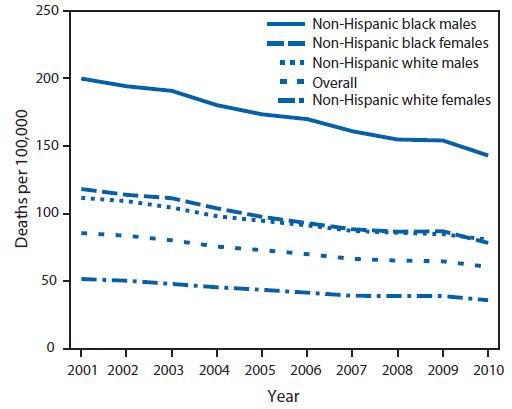
The information reported in the media was taken from the Centers for Disease Control and Prevention's Sept. 3 Morbidity and Mortality Weekly Report. As the DMCB understands it, the CDC authors pulled 2001-2010 mortality data from the National Vital Statistics System. Once that was done, they counted up the number of persons aged less than 75 years who died of "ischemic heart disease," "cerebrovascular disease," hypertensive disease" or "chronic rheumatic heart disease."

So what did MMWR really say?

The total of "less-than-75" deaths in 2001 was 227,961.  For 2010, it was lower at 200,070. Since the population in the U.S. has changed over the last decade, the totals for each of the two comparison years were then expressed as a "per 100,000" statistic.

Since 2001, the "less-than-75" death rate per 100,000 declined by 29%.  The decline averaged 3.8% a year.* Persons age 65-74 years had an average decline of 5.1% vs. 3.3% persons between the ages of 55-64. 

The good news is that Black (3.9%) and Hispanic (4.5%) persons had greater declines than whites (3.6%). The bad news is that they started and ended with a higher death rate.

Here's a visual display of the data:


 The DMCB's take

1. "Avoidable?" The CDC definition implies that perfect control of all cardiac risk factors (for example, cholesterol and weight) for everyone under the age of 75 will result in a 0 per 100,000 cardiovascular death rate. Not so, because those risk classic factors capture some, but not all, persons who succumb to heart attack and stroke.

2. So, this is bad news?  "200,000" deaths is an impressive number, but, on an unadjusted basis, that's about 28,000 fewer compared to 10 years ago. Some additional good news is that the U.S. rate of non-fatal heart attack and stroke appears to have dropped significantly alsoWe are making significant headway in the battle against heart disease.

3. The real story? Persons of color have had the greatest relative benefit but still have the greatest absolute need.  That lingering health care disparity went shamefully unmentioned by CNN and was only briefly mentioned by USAToday.

4. Something for everyone: In their "Conclusions and Comments," the authors of the MMWR paper speculated on the benefits of the (still unproven) Million Hearts Initiative (a Berwick-era idea) as well as "health information technology" and various "community prevention strategies" The DMCB's colleagues in the care management service industry will really like the authors' nods toward "team based care" and how "individuals can work toward reducing their own heart disease and stroke risk."  If the CDC says so, it must be true - assuming there's a good business model.

5. Speaking of speculation, the authors wondered if the greater decline in the Medicare age group (65-74 years) versus the younger age group (55-64) was because of the presence of health insurance. Maybe, but maybe not.  The DMCB also wonders if heart disease is more lethal and less amenable to intervention among younger persons, but can't find any literature to back that up.

6. Politics intrude:  Naturally, the scientists who write MMWR are too classy than to curry favor with the appointees that populate the upper echelons of the federal bureaucracy, but that didn't stop the CDC Vital Signs from shamefully putting in a "making it easier for Americans to afford regular preventive health care through the Affordable Care Act" plug.  The ACA was not mentioned in the MMWR report because the declines mentioned above occurred in the absence of the ACA

The DMCB predicts that when the "avoidable" death rate continues to decline by 3.8% in the coming years, Obamacare advocates will take the credit.


*The DMCB isn't sure how 3.8% for 10 years makes for 29% either, but that's statistics for you.

Image from Wikipedia
Leaderboard