Leaderboard
728x15
Showing posts with label Primary Care. Show all posts

"Down Jobbing" to Primary Care Technicians?

Heard of "down-jobbing?"
Your PCT will see you now.....

The Disease Management Care Blog first became aware of the term years ago when it was pointed out that primary care docs can take on some specialty care responsibilities, while nurses can take on primary care roles, while office assistants can take on nursing roles. A parallel phenomenon is the movement of surgeries and other medical procedures from the inpatient to the outpatient surgi-center to the physician's office.

Naturally, the ultimate down-jobbing target is the patient. Examples include the reasonable innovation of self-service kiosks as well as emergency or wacky "self surgery."

Which naturally prompts the DMCB to offer it's own definition of down-jobbing: the historical movement of medical treatment from higher to lower levels or locations of health care services.

Of course, the major driver of down-jobbing is economics. DMCB readers are well aware of our national obsession with transitioning from "fee-for-service" (FFS) to more "value-based" reimbursement arrangements. These include pay-for-performance as well as shared-risk, global or other capitated approaches.

Since traditional FFS is notoriously linked to medical necessity as well as provider credentialing (examples are not hard to find), physicians have had little incentive to go along with down-jobbing. As FFS allegedly goes the way of the dinosaurs (a perspective likewise not hard to find), health care providers in these new value-based payment systems are looking for cost-effective ways to service their patients within a fixed budget or fixed payment system. One way to do that is to down-job.

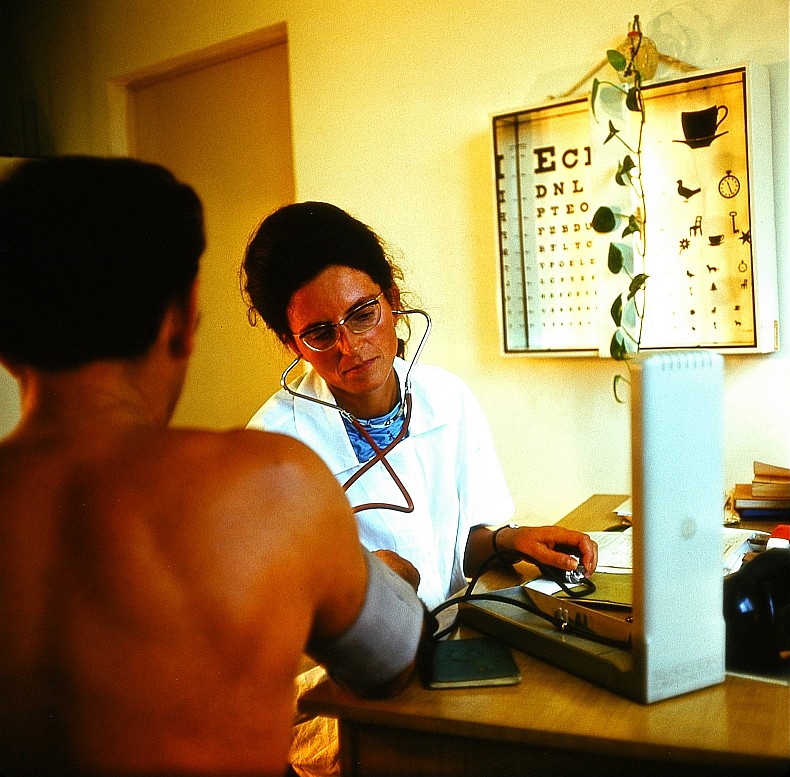
So it was only a matter of time until someone thought of the option of "primary care technicians" ("PCTs") as a value-based and down-jobbed solution to the nation's physician shortage. As Kellermann et al point out in the November 2015 issue of Health Affairs, the pipeline for primary care docs, physician assistants, nurse practitioners is not only expensive, it's unlikely to meet future demand.  They argue that PCTs can be to primary care providers like emergency medical technicians (EMTs) are to emergency care rooms.  Like EMTs, PCT training to handle preventive care, treatment of minor illnesses and monitoring chronic conditions needn't be extensive. That's especially true if PCTs are armed with a health IT safety net that provides tablet-based decision-support algorithms that are ultimately tethered to (or teamed with?) a primary care physician.

So there you go: a few questions, a cursory exam and a recommended treatment plan for millions of healthcare hungry Americans is well within reach.  All it takes is some additional down-jobbing.

The DMCB thinks that, on paper, it's not a bad idea and no accident that it would appear in the academic health policy literature.  Whether this could gain any traction in the real world of patients remains to be seen.  Perhaps the next step is a randomized controlled clinical trial comparing the outcomes of patients seeing newly minted PCTs to those receiving usual care.

The DMCB has two additional concerns:

1. The promise of the expansion of access to health insurance under the current iteration of health reform was that patients would be able to access the current health care system, including doctors and hospitals.  Even if this system of primary care meet outcome expectations, this will hardly burnish American's ambivalent views of Obamacare.

2. Liability concerns are significant. Allegations of malpractice are inevitable with PCTs and their supervising docs will naturally worry about being ensnared in even more lawsuits by a very nimble plaintiffs' bar.

Image from Wikipedia
The Philosopher King Approach to Health Care Payment Reform: Commissions, Councils, Task Forces, Panels and Lawyers

Paying for it is a whole new kettle....
Now that the U.S. Supremes have confirmed the Affordable Care Act as the law of the land, the Next Big Step - as the Disease Management Care Blog predicted - is the move from insurance reform to payment reform. While it's politically easy to broaden entitlements to cover everyone, figuring out how to pay for it is a whole new kettle of financing fish.

In response, a who's who of Obamacaregineers are stepping up with their Phase II recommendations for payment reform.  While you ponder whether the DMCB summary below is enough or whether you need to follow the link for more detail, ask yourself what's missing......

1. Let public and private payers combine forces to "negotiate" payment rates that aim for global spending targets at a regional level.  Embedded costs for research, training and uncompensated care would be carved out and preserved separately.

 2. Use bundled payment methods for episodes of care that span rehab and post-discharge care, starting out with cardiology and orthopedics. Aim to make this payment approach the rule for 75% of Medicare's budget within 10 years.

3. Commoditize medical devices, lab tests and radiology services by forcing suppliers to competitively bid for Medicare's business.

4. Encourage tiered insurance products, where consumers can pick progressively lower premiums in exchange for higher out of pocket costs.

5. Leverage state exchanges to ratchet down costs on pain of being "delisted" by forcing them to compete on cost and quality.

6. Simplify administrative costs by establishing a single format for all paper and electronic forms. The latter is the default unless the consumer opts for paper.

7. Make the pricing for medical services public and outlaw gag clauses.

8. Allow non-physicians to take advantage of scope-of-practice  laws to practice medicine autonomously.

9. Close the provider self-referral loopholes that allow docs to provide "in house ancillary services," unless its under a global cap.

10 Start all the above with the Federal Employees Health Benefits Program (FEHBP).

11. Use the "safe harbor" of practice guidelines to protect docs against allegations of medical malpractice.

What's missing is the usual emphasis on primary care and, in particular, the patient centered medical home.  While it could be argued that global targets and bundled payment methodologies will drive the inclusion of higher value/lower cost non-specialists, the DMCB is shocked, shocked that the experts and editors missed usual nod to primary care.

The DMCB will also point out that the proposal is rich in expert councils (to set spending targets), programs (as in Medicare Acute Care Episode to define the bundling), panels (for the competitive bidding and guidelines) task forces (for the administrative simplification), commissioners (to assure transparency) and, last but not least lawyers (expanding Stark to ban self-referral).  Plato, the champion of Philosopher Kings, would be proud. 

In the meantime, Ayn Rand is rolling in her grave.

Image from Wikipedia

Just Because You Build It They Won't Come: What ACOs, PCMHs and Population Health Advocates Need to Know About Poverty and Emergency Room Use

Thinking about an ER visit.....
As part of a research requirement that it had to fulfill prior to medical school graduation, the young Disease Management Care Blog conducted a patient satisfaction survey. To its surprise, the DMCB discovered patients cared less about high touch primary care and more about access to high tech specialists.

It naturally ignored the income implications and became a general internist.

Fast forward to its job as a Medical Director in a not-for-profit physician-led managed care insurance plan.  No matter how much we "polished" the primary care network, emergency room utilization remained persistently high.

The CEO naturally ignored the DMCB's conclusion that there was little that could be done and assigned another medical director to the task.

Fast forward to Uncle Sam's Healthcare Fantasy Land, where ACOs and medical homes caring for patients with universal insurance will, thanks to the enlightened efficiencies of primary care, save gazillions of dollars by steering patients away from emergency rooms and hospitals.

All three scenarios came together when the DMCB read some research by group of Philadelphia docs who wanted to better understand why patients with low socioeconomic status kept ending up in emergency rooms and hospitals.

Best of all, to do this, they used a novel methodology: they found some patients and.... asked!

Their report appears in the latest issue of Health Affairs.

64 hospitalized patients with low socioeconomic status were approached to participate in a "qualitative" research interview (here's one example of how it's done). The patients were selected because they had been hospitalized via the ER multiple times, were between the ages of 18-64 years, were uninsured or on Medicaid, lived in a poor ZIP-code region of the city. 24 said no, leaving 40 subjects who agreed to have their interviews recorded. A rigorous analysis followed, with two "coders" who listened to the recordings and independently developed themes or ideas. They then circled back to the patients for confirmation.

Two themes emerged:

1) Convenience/Access: Even if they have access to primary care, the emergency room and inpatient setting remains the more convenient option.  That's because walk-in is available 24/7 and all testing as well as specialty care is available during a one-time visit.  Zero dollar primary care co-pays don't make up for the hassle, time and expense of calling ahead for appointments, arranging transportation (even if vouchers through Medicaid are available) or being referred for separate testing as well as specialty consultation.

2) Technology: Based on personal experience with their primary care docs, the emergency rooms and hospitals were perceived to have more technically proficient providers who were better able to achieve the correct diagnosis and render the correct treatment in a timely fashion.

A subset of patients seemed to come from chaotic life circumstances. Those patients found hospitals offered what the researchers described as "respite" and social "support."

The presence of Medicaid insurance had little to do with the attitudes described above.

The DMCB's take:

While subjective qualitative research is viewed with disdain by researchers, policymakers and journal editors, occasionally, good studies like this comes along.  This article sheds important light on a potential Achilles heel of accountable care organizations (ACOs) as well as the patient centered medical home (PCMH).

That Achilles heel? Just because you build it, these 40 patients - and millions who live in poverty like them - won't come.

What's more, they are making rational decisions.

The authors point out that system solutions include co-locating multiple services (primary care, labs, x-rays and specialists), improving the quality of primary care and, when possible, mitigating any social challenges. The DMCB agrees, but is unaware of any ACOs or medical home initiatives that, outside of the usual process measures, specifically address these patients' special concerns.

The DMCB's suggestions:

Advocates for ACOs and the PCMH need to get real, lower expectations and recognize that a key solution to the problem of health care overutilization by persons in poverty is to stop politicians and health care leaders from medicalizing poverty. 

That being said, one possible solution for ACOs and PCMHs serving fragile patients with poverty is high intensity biopsychosocial intervention.  It sounds expensive but full time community-based care management with low case loads and lots of physician support may help ameliorate some of the dysfunction.  It's probably less expensive than all those hospitalizations.

Finally, this may be an opportunity for nimble population health management service providers.  If any are already out there serving this population, the DMCB would like to know about it.

Image from Wikipedia

Three Models of Primary Care Teaming (TL, CC and ET): An Unexplored Feature of the Medical Home

What defines optimal outpatient primary care "teaming?"

The Disease Management Care Blog just assumed that if it took equal scoops of adaptable physicians, dedicated nurses and supportive culture and baked with a dollop of accountability, "teaming" would just.... happen.

It turns out that what may come out of that clinical practice oven is a lot more complicated than that. 

Which is why medical home advocates should pay attention to this article by George Washington University's Debra Goetz Goldberg and colleagues.  Interested in finding out more about primary care "teaming," they interviewed, reviewed and observed three different Virginia clinics that had embarked on transformative quality improvement programs.

Each clinic came up with a different version of "teaming":

1."Top of License" - nurses interviewed the patients, presented the problems to the docs and then documented the care plan.  They were also responsible for the patient education.  Thanks to using this model, the physicians almost doubled the number of patients they were seeing per day.

2. "Care Coordinator" - nurses focused on helping patients undergoing care "transitions" (typically out of the hospital) and provided self-management and health education to high-risk, high complexity patients.  Interestingly, unsatisfactory reimbursement levels forced the practice to cut back, but they still doubled mammography and blood pressure control rates among persons with diabetes mellitus.

3. "Enhanced Traditional" - the physicians still performed the bulk of the patient care but the researchers observed that the other clinic personnel benefited from increased trust, communication and hand-offs that translated into patient centered care, shared responsibility and heightened volunteerism.  The practice was unable to measure any outcomes.

"Very interesting!" says the DMCB. Authoritative web-sites like this or this and peer-reviewed articles like this refer to "teaming," but fail to precisely define it.  Assuming the three categories described by Goetz-Goldberg (in shorthand, "TL," "CC" and "ET") hold up in future studies, the DMCB looks forward to learning which approach results in the greatest quality or cost-savings.

Coda: As a reader bonus, the authors offer up a definition of "team-based care" that seems to span all three models and can be used for the DMCB readers' quoting pleasure:

"A group of diverse clinicians who participate in and communicate with each other regularly about the care of a defined group or panel of patients."
Leaderboard